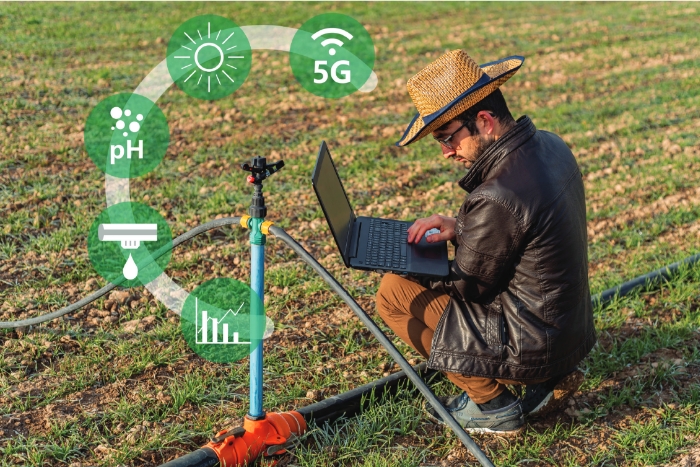
During the Irrigation Association’s General Session at the 2025 Irrigation Show and Education Week in New Orleans, John Farner, executive director, land and water, for the Lincoln Institute of Land Policy in Cambridge, Massachusetts, made a statement that should resonate across every segment of our industry: “Irrigation systems must be more than water delivery systems.” It is a simple line, but one that captures a fundamental shift already underway in modern agriculture and one that challenges how we design, evaluate and manage irrigation infrastructure going forward.
For decades, irrigation performance has largely been judged on a single metric: how uniformly water is applied. Distribution uniformity (DU) has been the gold standard and rightly so. Without consistent water delivery, crop performance, yield and resource efficiency suffer. But as Farner suggested, focusing solely on water ignores the reality of today’s production agriculture. Modern irrigation systems are increasingly tasked with delivering a complex mix of inputs: fertilizers, nutrients, crop-protection products, biostimulants and even dissolved gases such as oxygen. If these inputs are not applied as uniformly as the water itself, precision agriculture falls short of its promise.
Fertigation and chemigation are no longer niche practices. They are essential tools for improving nutrient-use efficiency, reducing labor and responding quickly to crop needs. Yet many systems are still evaluated as if water is the only variable that matters. In reality, the uniformity of nutrient concentration at the root zone is just as critical as the uniformity of flow at the emitter.
A system may demonstrate excellent hydraulic DU while delivering inconsistent nutrient concentrations due to poor mixing, inadequate injection control or flow variability across zones. From a crop’s perspective, that inconsistency can translate into uneven growth, wasted inputs and diminished returns. Precision agriculture demands that we broaden our definition of “uniformity” to include all inputs moving through the irrigation system.
Precision agriculture demands that we broaden our definition of “uniformity” to include all inputs moving through the irrigation system.
One of the most interesting developments in this expanded view of irrigation is the growing recognition of oxygen as a beneficial input. Oxygenated irrigation water has been shown to support healthier root zones, improve nutrient uptake and mitigate stress in compacted or poorly aerated soils. In high-frequency irrigation systems, where soils may remain near saturation, dissolved oxygen can be a limiting factor for root respiration and microbial activity.
Venturi-based injection systems have become a proven and practical way to introduce oxygen into irrigation water. By leveraging pressure differentials already present in the system, venturi injectors can reliably entrain air or oxygen and dissolve it into the water stream without requiring moving parts or external energy inputs. The result is a consistent supply of oxygenated water distributed throughout the irrigation network.
Nanobubble technologies have also entered the conversation, offering extremely small gas bubbles with long residence times. While promising in certain applications, they currently play a more limited role compared to venturi systems, particularly when scalability, cost and integration with existing infrastructure are considered. Regardless of the method, the key takeaway is that oxygen is no longer just a byproduct — it is an intentional input that must be delivered uniformly to be effective.
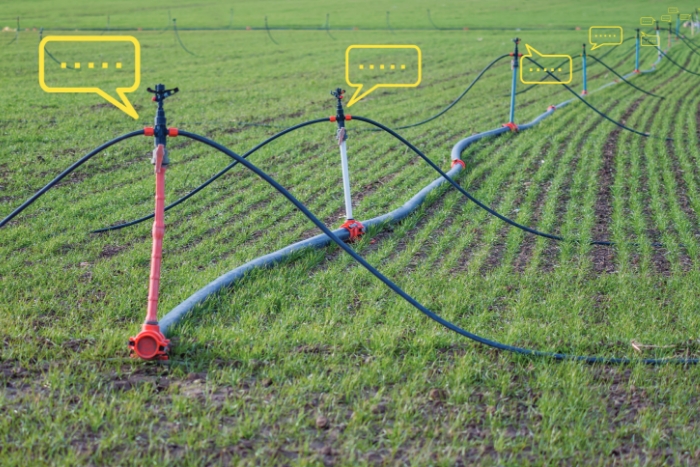 Rethinking DU
If irrigation systems are delivering water, nutrients, chemicals and oxygen, then DU must be redefined accordingly. Traditional DU measurements focus on flow and pressure. Modern evaluations should also consider concentration uniformity of injected inputs. Are fertilizers mixed thoroughly before reaching the field? Are biostimulants distributed evenly across laterals? Is dissolved oxygen maintained from injection point to emitter?
For precision agriculture to truly be precise, variability in any one of these inputs must be understood and minimized. This may require better mixing and contacting technologies, improved system design and updated testing protocols that reflect the multifunctional role of modern irrigation systems.
Farner’s statement was less a critique of past practices and more a call to action. As water scarcity, input costs and sustainability pressures increase, irrigation systems must do more with the same — or fewer — resources. That means designing systems from the outset to handle multiple inputs reliably and uniformly, not treating fertigation or oxygenation as afterthoughts.
It is also a reminder that smart irrigation is not just about technology but about intent. When we view irrigation systems as integrated delivery platforms rather than simply plumbing, we open the door to better agronomic outcomes, improved resource efficiency and more resilient farming operations.
In that sense, irrigation systems being “more than water delivery systems” is not a future aspiration; it is the present reality. Our challenge as an industry is to ensure our metrics, designs and best practices evolve to match it.