
Home » News + Features » Water » Colorado River and California: Managing allocation drought while keeping agriculture productive
Editors note: This article is the first of a three-part series on drought, starting with the western United States, moving to the Plains and then the East.
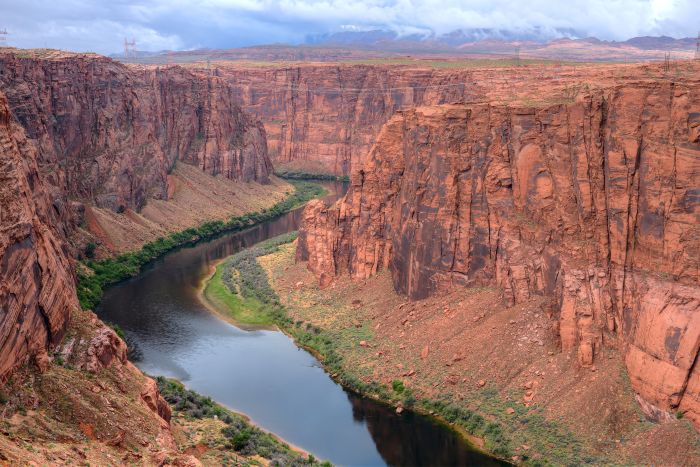
Drought in the Western United States is often talked about in terms of weather – snowpack, rainfall, reservoir levels. For growers in the Colorado River Basin and across California, drought is increasingly experienced in a much more practical way: through allocation.
It’s not just about whether water is available. It’s about how much will be delivered, when it will arrive, and how those constraints will shape an entire growing season.
For irrigated agriculture, that shift has real economic implications. Crops like alfalfa are foundational to farm viability and to the broader agricultural economy. Alfalfa supports dairy and beef production, anchors crop rotations, and in places like California’s Central Valley contributes roughly $1.2 billion annually in economic value.
Because of that, drought-driven decisions don’t happen in isolation. When water supplies tighten, the question is not simply how to reduce use. It becomes: What happens if productive acreage is taken out of the system?
In many recent discussions, one near-term response has been to temporarily reduce demand, sometimes through compensated conservation or fallowing programs. These efforts can play an important role in stabilizing water systems during critical periods. They also introduce a tension that many growers are navigating in real time: how to meet conservation targets while still maintaining a viable operation.
Taking acres out of production can reduce water use quickly. However, it also means fewer harvests, less economic activity, and disruptions that extend well beyond the farm gate. For crops like alfalfa, that ripple effect is especially visible, given how tightly it is connected to regional livestock systems and local economies.
This is where irrigation planning has become more intentional and often more disciplined than ever before. Planning now starts well before the season, with growers assessing expected allocations and deciding how to prioritize fields, crops, and water use across the farm. Once irrigation begins, each application carries more weight. Over-irrigating is no longer just inefficient; it can limit a farm’s ability to make it through the season.
At the same time, there is a growing recognition that not all drought responses are equal in how they shape the future of agriculture. Short-term conservation can create necessary flexibility in the system. On its own, it does not change how water is used on the farm.
That’s where longer-term investments in irrigation performance begin to matter more. Improvements in distribution uniformity, better control over application timing, and systems that reduce losses below or beyond the root zone can all contribute to lower overall demand – without requiring land to be taken out of production.
For many growers, that distinction is becoming central to how they think about drought. It’s not simply a question of using less water. It’s a question of how to continue producing under tighter constraints.
Water professionals have always understood that irrigation decisions extend beyond yield. In this region’s allocation-driven environment, those decisions are increasingly tied to economic resilience as well. For crops like alfalfa, and for the communities that depend on them, maintaining productive agriculture while reducing water demand is not an abstract goal. It’s the practical challenge in front of the industry right now.
How that balance is managed will shape what irrigated agriculture looks like in the West going forward.
Prepared with the support of AI.
Val Fishman is advocacy and development consultant for Orbia Precision Agriculture
Share on social media:
3030 Clarendon Blvd. | Suite 300 | Arlington, VA 22201
Tel: 703.536.7080 | Fax: 703.536.7019
HOME | ABOUT US | ADVERTISE | SUBSCRIBE | CONTACT | PRIVACY POLICY | IA ANTITRUST STATEMENT