
Home » News + Features » Irrigation » The voices of smart irrigation: Stories from the pros at the forefront of water efficiency
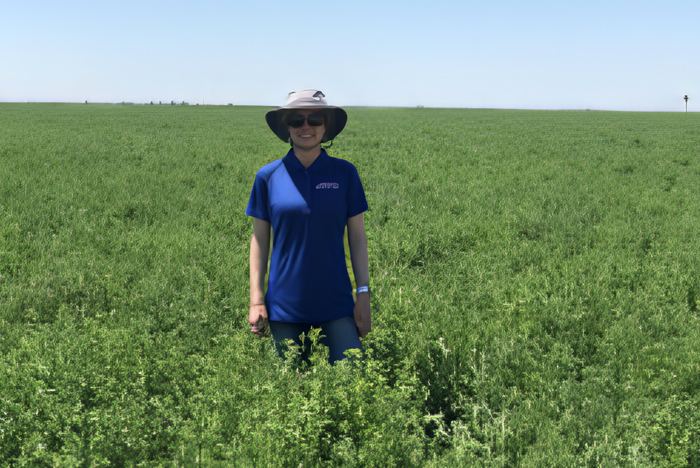
Val Fishman of Netafim, Orbia Precision Agriculture has been working in the irrigation industry for five years. As an advocacy and development consultant, she works at the intersection of agriculture, industry and sustainability to accelerate the adoption of smart irrigation. Fishman helps translate corporate commitments into on‑farm impact, delivering measurable environmental benefits while supporting the long‑term viability of farming communities.
What first pulled you into irrigation—and what’s kept you in it?
Prior to my current role, I spent 11 years at an environmental nonprofit, where much of my work focused on helping shape what is now known as corporate water stewardship. Through that experience, I came to see agriculture as one of the most direct ways to make a meaningful impact on both water use and climate outcomes.
One of the technologies that really stood out during that time was subsurface drip irrigation using manure effluent. Netafim later patented this as “SDI‑E.” It was a clear example of how innovation in irrigation could unlock both environmental and operational benefits for farmers.
What’s kept me in this space is the opportunity to keep learning about farming systems, what motivates change on the ground, and the real barriers and accelerators to progress. It’s a dynamic, constantly evolving field, and that combination of impact and complexity continues to challenge and inspire me.
How do you work to be a champion of promoting smart irrigation?
I see promoting smart irrigation as both a funding and a connection challenge. My role is to help bridge that gap by connecting farmers with the financial resources they need to modernize their systems.
While I’ve done some work in the public sector – particularly around improving access to state and federal funding programs – most of my time is spent working with the private sector. I collaborate with food and beverage companies, consumer goods brands, and technology companies that are investing in agriculture as part of their sustainability strategies. I help align those investments with real opportunities on the ground.
I also appreciate the opportunity to contribute to the Irrigation Association’s News Harvest newsletter, which allows me to share what I’m seeing and help promote broader adoption of smart irrigation practices.
With drought affecting many areas of the country this summer, what role can smart irrigation play in helping communities reach their water saving goals?
Smart irrigation is one of the most practical tools we have for meeting water-saving goals because it improves how water is used – not just how much is saved. In the West, it helps farmers adapt to limited allocations without taking land out of production. In groundwater-dependent regions, it stretches finite supplies by making each irrigation decision more precise. In regions facing flash drought, it supports faster, more proactive responses before stress impacts yield.
Across all regions, the value comes down to precision – better timing, better system performance, and better information. That’s what allows agriculture to reduce water use while remaining productive, which is essential for both farm viability and community resilience.
If you could snap your fingers and fix one barrier to smarter irrigation adoption, what would it be?
If I could snap my fingers and fix one barrier, it would be making funding more accessible and easier for farmers to use.
There’s no shortage of technologies or solutions. We already have many proven ways to improve irrigation efficiency. The challenge is that adoption can be slow because even when funding exists, it can be difficult to access, slow to deploy, or not aligned with how decisions are made on the farm.
Closing that gap by making funding more accessible, consistent, and practical would go a long way toward accelerating adoption. Farmers are already highly adaptive; the opportunity is to better support their ability to invest in improvements that reduce water use while maintaining productivity.
Share on social media:
3030 Clarendon Blvd. | Suite 300 | Arlington, VA 22201
Tel: 703.536.7080 | Fax: 703.536.7019
HOME | ABOUT US | ADVERTISE | SUBSCRIBE | CONTACT | PRIVACY POLICY | IA ANTITRUST STATEMENT