Water is a vital resource for every grower, and with drought coverage at a 3.5-year high, employing drought-mitigation strategies is essential to preserving yield and maintaining crop health — no matter the weather conditions.
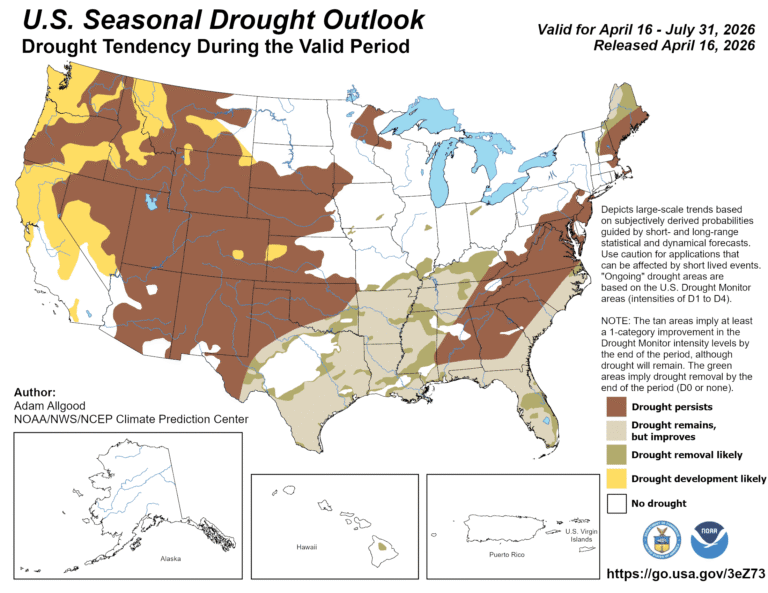
“According to the latest U.S. Drought Monitor, dated April 7, drought coverage across the Lower 48 states is 60.05%, greatest since Nov. 8, 2022,” says Brad Rippey, U.S. Department of Agriculture meteorologist with the Office of the Chief Economist in Washington, D.C. “Looking ahead, the Seasonal Drought Outlook from the National Weather Service suggests that drought could develop or further intensify from the Pacific Coast to the Plains during the spring and early summer, with potential impacts on rangeland, pastures, winter wheat, spring-sown crops and irrigation reserves.”
Depending on geographical location, the depth to groundwater and the cost to apply irrigation, some growers may not realize the value of drought-mitigation strategies or efficient use of water on a yearly basis, but Justin Gibson, PhD, senior manager of digital agronomy for Lindsay Corporation in Omaha, Nebraska, makes the case that water management strategies should be top of mind for every grower.
“Water is an inelastic resource; it’s not worth a lot until it is,” Gibson says. “Once it’s gone, you understand the value of water.”
While some growers may have high enough margins across the farm to make a profit on their baseline practices, Gibson says that when commodity prices get lower, growers are typically forced to explore ways to be more efficient.
“Sometimes inefficiencies can be tolerated across the farm, and as a grower, I might do other things to make money across the farm,” Gibson says.
While drought-mitigation strategies are a no-brainer for growers in many parts of the country, the best way for all growers to protect yield is to plan ahead.
“The biggest shift is planning for water limits before they become a hardship,” says Melissa Lilze, senior vice president, North America, of Netafim in Fresno, California. “Growers who hold yield best understand their crop water needs and get intentional about the timing of irrigation. They apply water when it benefits the crop and not when it won’t. When water is limited like it is today, eliminating waste is the fastest way to protect your yield.”
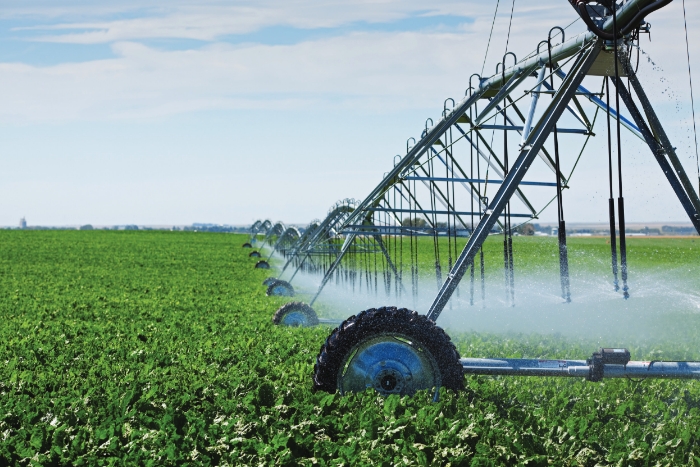
While drought mitigation involves a combination of practices from monitoring to scheduling, the first step is ensuring that the irrigation system is well maintained and uniform — clogs, leaks and pressure issues should all be corrected first.
“If the system isn’t performing uniformly, the schedule won’t save you,” Lilze says. “You can’t overwater your way out of poor system uniformity. You can apply more water, but it isn’t going to fix the root of the problem: that your system isn’t applying the same amount of water and nutrients throughout the system, and your yield won’t be uniform across the field.”
Sprinkler design is one key way to improve uniformity.
“Sprinkler design can help make sure that you’re not losing a lot of water to drift away from the field from hot, dry wind conditions, so the water you’re pumping is being evenly applied across the field,” Gibson says. “You have to get your house in order first before drought conditions. This applies to any grower.”
“Growers who hold yield best understand their crop water needs and get intentional about the timing of irrigation. … When water is limited like it is today, eliminating waste is the fastest way to protect your yield.”
— Melissa Lilze, senior vice president, North America, Netafim
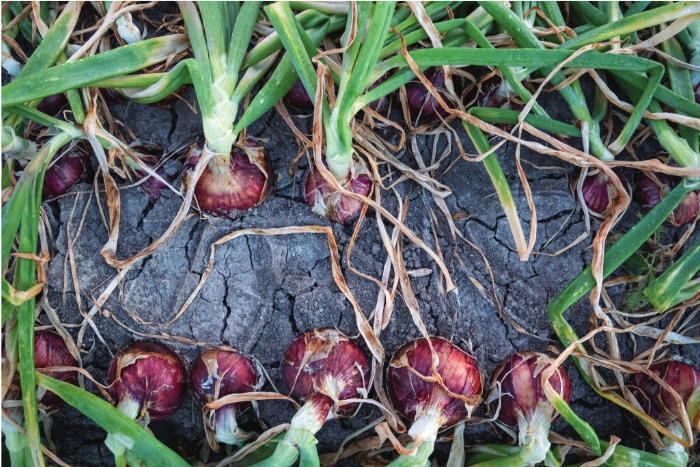
For growers without drought-mitigation strategies in place, Lilze says measuring soil moisture and monitoring weather are essential to understanding how and when to water.
“With those, you can start to build a schedule based on your farm,” Lilze says. “Your soil type tells you how much water to apply without pushing water past your root zone because of the water-holding capacity of your soil type.”
If there is a finite amount of water, strategic application developed with an understanding of crop needs, soil conditions and weather conditions is essential.
“Pay attention to what is going on environmentally and in the field, because that’s where irrigation scheduling becomes critical,” Gibson says. “What is the crop water use? How much irrigation have I put on already? Do I need to water? Even though it’s hot and dry and my neighbors are watering, maybe I don’t have to. Maybe we are getting close to drought, but weather conditions say it might rain. If you have a finite amount of water, be strategic about where you’re putting it on the field.”
As irrigation technology improves and expands, tools that tell growers the precise crop water required and where it should be applied have become more accessible, in terms of both cost and usage.
“Maybe 10 years ago, people thought the cost to adopt this type of technology was overwhelming,” Lilze says. “As technology has evolved, we see newer, smarter, more robust technology that we can deploy into the field and can be scaled more cost effectively, so barrier to entry of cost isn’t there anymore.”
Gibson says that USDA surveys suggest that around 30% of U.S. growers are using a quantitative irrigation scheduling tool.
“From our perspective, drought mitigation is fundamentally about digitizing your irrigation decision, forecasting and modeling outcomes before they happen, being precise about where you water from field to field, and really connecting equipment and data,” Gibson says.
Lilze says that more growers are realizing the value of technology to support their operations.
“We’re seeing really strong adoption of digital farming in places like California, Texas and the Southwest regions because water tracking and operational efficiency have to become part of everybody’s focus,” she says. “Remote monitoring and control can help growers apply water more precisely and reduce labor trips to the field. You can automate your irrigation system, take feedback on soil moisture data, schedule irrigation remotely and not have to send an irrigator or farm manager to the field. It’s all done automatically.”
While the efficient use of water is certainly one benefit of automation, there are several reasons to consider implementing drought-mitigation strategies.
“Other benefits of automation are reducing the hands-on time required to manage irrigation and using scheduling to shift pumping to off-peak hours to help manage energy costs, especially when margins are tight,” Lilze says. “Being able to meet crop water demands on off-peak hours can be difficult on farms with smaller irrigation sets on large acres, so using these tools to schedule and then maintain those off-peak hours is important for growers.”
Gibson says more growers are realizing that responsible water use has clear positive effects on their bottom line.
“Folks are paying attention and see that being a responsible steward of water has real [return on investment] impacts,” Gibson says. “It reduces energy costs and possibly fertilizer costs because you aren’t flushing as much in the soil, and that helps in an average year but gives more ability to adjust to drought conditions in the first place.”