
Home » News + Features » Irrigation » New study shows ag irrigation can offset greenhouse gas emissions
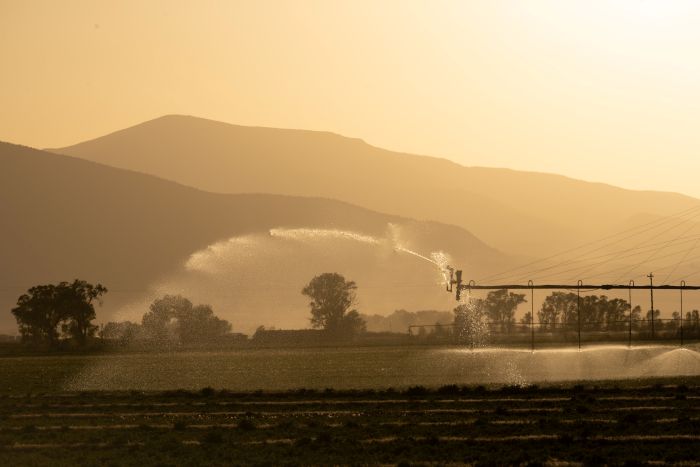
Agricultural irrigation requires energy and can contribute to greenhouse gas emissions, but it also allows growers to produce more on fewer acres. New research from Colorado State University shows that the productivity gains irrigation creates outweigh the greenhouse gas emissions a system creates during operation.
Researchers found that if currently irrigated U.S. cropland stopped completely, converting new land to achieve the same yields as irrigated crops could generate sustainably more greenhouse gas—as much as 363 times more.
“Irrigation allows crop production to be more productive and more resilient, and allows us to produce more food on less land,” said Nathan Mueller, study co-author and data scientist who leads CSU’s Agricultural Sustainability and Climate Impacts Lab. “But irrigation also leads to some direct greenhouse gas emissions. We wanted to put the pieces together and compare these greenhouse gas costs and benefits as clearly as possible.”
Previous studies examined emissions associated with on-farm pumping, inter-basin transfers, increased nitrous oxide emissions and groundwater degassing, according to Mueller. The new study provides the other half of the picture: if currently irrigated cropland in the U.S. shifted to rainfed production, how would the resulting production losses reshape agricultural land use, and what would the emissions consequences be?
“We answered this question through comprehensive analysis of paired rainfed and irrigated yield data, modeling the agricultural economy, and detailed estimates of the carbon costs of land conversion,” he explained.
How irrigation can reduce greenhouse gases
According to the study, the increased productivity associated with irrigation represents 6.86 gigatons of avoided greenhouse gas emissions from land-use change. Researchers estimated that avoided emissions equal roughly 300 years of irrigation’s current annual emissions.
“These findings show that we need to think about productivity and both direct and indirect emissions when we consider what makes a practice climate-smart,” Mueller said.
The data adds another talking point to discussions about agriculture’s environmental footprint. Current conversations often focus on water and energy use and those impacts, but the new research demonstrates that productivity should be part of the message too.
“It’s important to understand that irrigation’s productivity has a real greenhouse gas benefit once you account for avoided land use change,” Mueller said. ““That benefit can grow further by cutting pumping emissions, the largest source of direct emissions of irrigation. Policymakers and the irrigation community could consider how to help farmers using gas or diesel pumps make the switch to electric pumps, which would help reduce emissions in the long run.”
Water use is a complicated issue that extends beyond emissions. The dialogue should also acknowledge declining groundwater and depleted aquifers.
“In places where aquifers are declining or rivers are over-allocated, water sustainability has to come first,” he said. “Our results aren’t a blanket case for expanding irrigation everywhere. The climate benefit comes from the additional productivity, so it only lasts as long as the water supply does.”
The source of irrigation water also affects greenhouse gas emissions. Groundwater supplies about half of U.S. irrigation water but accounts for nearly 80% of irrigation’s direct emissions, according to Mueller. Much of that comes from the energy required to pump groundwater to the surface. Nationwide, those direct emissions are still small relative to the land-sparing benefit irrigation provides.
Future research
The research team modeled an all-or-nothing irrigation scenario. Mueller said future research could examine more realistic irrigation changes as use declines or grows based on warmer climates, water scarcity and crop changes.
“We also need more measurements of nitrous oxide emissions from irrigated and rainfed fields side by side to improve our estimates of the nitrous oxide impacts of irrigation,” he said.
The broader takeaway, he said, extends beyond irrigation. Evaluating both the direct emissions associated with an agricultural practice and its effects on productivity and land use could provide a more complete picture of climate implications of other farming practices too.
“Big picture, the approach we developed to look at both direct and indirect emissions could be used to evaluate other farming practices, like cover crops or nitrogen management, so we get the full climate picture for those too,” he said.
Photo courtesy of Colorado State University.
Share on social media:

3030 Clarendon Blvd. | Suite 300 | Arlington, VA 22201
Tel: 703.536.7080 | Fax: 703.536.7019
HOME | ABOUT US | ADVERTISE | SUBSCRIBE | CONTACT | PRIVACY POLICY | IA ANTITRUST STATEMENT