
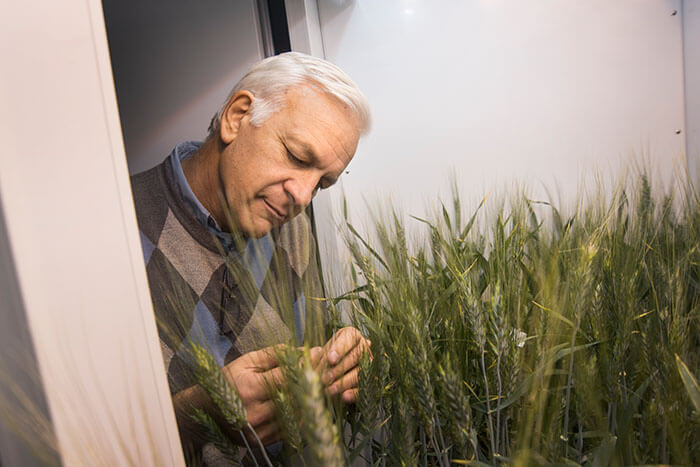
The University of California, Davis, Davis, California, will guide a five-year, $15 million research project to expedite wheat breeding in order to meet new climate realities.
Thanks to a grant from the U.S. Department of Agriculture’s National Institute of Food and Agriculture, more than 40 wheat breeders and researchers from 22 institutions across 20 states will come together to perform expansive analyses and reduce redundancies. Researchers from Mexico and the United Kingdom will also be involved.
“This grant allows us to do breeding at a level that a good, modern company would do,” says Jorge Dubcovsky, a UC Davis plant sciences distinguished professor who is leading the grant research. “This grant is essential to maintain modern and effective public breeding programs in the U.S.”
The program involves research, molecular molecule identification and data analysis spanning numerous institutions in order to discover genes able to help wheat crops diminish climate change effects. The next step includes plant breeding to prove the findings.
Unlike other crops, 60% of wheat varieties are developed by public breeding programs. Wheat growers tax themselves in order to support basic breeding efforts at public institutions including UC Davis.
A team in Texas will analyze plant images photographed by drones at each institution to pull out information regarding plant growth, water use and nitrogen levels. This data will allow researchers to document the plants’ lifecycles and decide which plant works better in certain conditions. Altogether, discoveries made through this could speed up breeding lifecycles and thus aid wheat crops with adaptation.
“If we can breed fast, we can adapt to change,” says Dubcovsky. “We are trying to make sustainable improvements in time.”
UC Davis’ wheat breeding project will also train a cohort of 20 plant doctoral students in active breeding programs through online and face-to-face workshops, educational events and national scientific conferences. There, students will take part in fieldwork, collect data from drones and DNA samples, and integrate that information to expedite wheat breeding.
The following are the other participating U.S. institutions:
• Colorado State University
• Cornell University
• Kansas State University
• Michigan State University
• Montana State University
• Oklahoma State University
• Purdue University
• South Dakota State University
• Texas A&M University
• University of Idaho
• University of Illinois
• University of Minnesota
• University of Nebraska
• University of Wisconsin
• Utah State University
• Virginia Tech
• Washington State University
• U.S. Department of Agriculture, Agricultural Research Service branches in North Dakota, Washington, Kansas and North Carolina
Share on social media:
3030 Clarendon Blvd. | Suite 300 | Arlington, VA 22201
Tel: 703.536.7080 | Fax: 703.536.7019
HOME | ABOUT US | ADVERTISE | SUBSCRIBE | CONTACT | PRIVACY POLICY | IA ANTITRUST STATEMENT