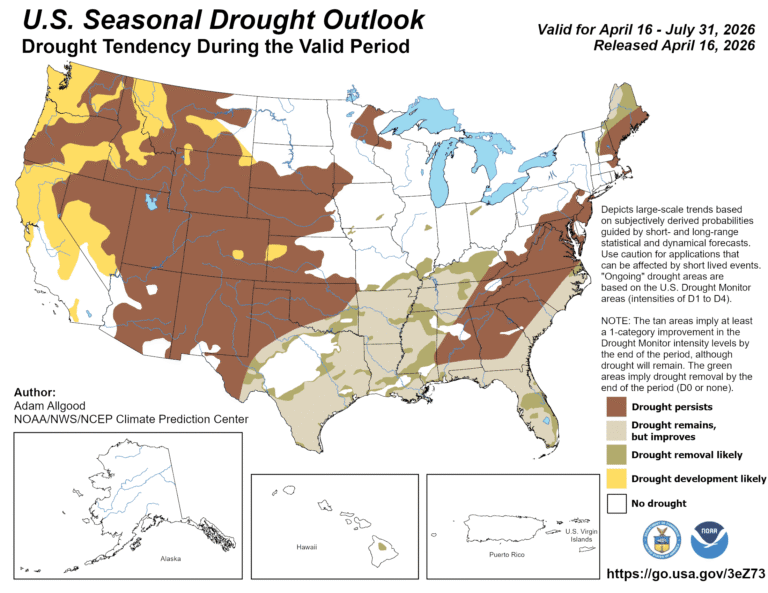
Heading into autumn 2022, drought continues to dominate the U.S. landscape from the Pacific Coast to the Great Plains, despite a robust North American monsoon circulation and some recent downpours on the southern Plains. According to the U.S. Drought Monitor, drought has consecutively covered more than 40% of the contiguous United States for nearly two years since late-September 2020, a 21st century record. In addition, La Niña is poised to return for a third consecutive autumn and winter, presaging drought persistence into early 2023 across much of the southwestern and south-central U.S.
As the seasons change, U.S. farmers are starting to assess drought impacts from the summer of 2022 and looking ahead to the autumn growing cycle, which includes sowing cover crops and winter wheat planting, emergence and establishment. Some of the most profound drought impacts in 2022 have occurred across the central and southern Great Plains, involving crops such as cotton and sorghum. Notably, in its first cotton estimate of the year, the U.S. Department of Agriculture pegged national harvested area at 7.13 million acres, which if realized would be the fewest cotton harvested acres since 1868. The same report noted expected production declines of 28% for U.S. cotton and 36% for sorghum, compared to 2021.
Finally, the long-running Western drought continues to affect surface water availability, especially in larger reservoirs such as those in the Colorado River Basin and along the Rio Grande. The Western water crisis, ongoing in spite of this summer’s scattered to widespread monsoon showers, continues to force decision-makers into difficult decisions regarding allocations for municipal, agricultural, industrial, recreational and environmental interests. On a bright note, producers across the northern U.S. have benefited from far better growing conditions in 2022, as compared to a year ago. Wetter weather in the North, partly related to the continuation of La Niña, led to improved rangeland and pasture conditions, as well as markedly improved output for crops such as spring wheat and durum wheat. In fact, U.S. durum wheat production is expected to be nearly double the previous year, up 97% from 2021, while spring wheat production is forecast to rise 55% from last year’s drought-ravaged crop.
3030 Clarendon Blvd. | Suite 300 | Arlington, VA 22201
Tel: 703.536.7080 | Fax: 703.536.7019
HOME | ABOUT US | ADVERTISE | SUBSCRIBE | CONTACT | PRIVACY POLICY | IA ANTITRUST STATEMENT