

Growers are under increasing pressure to make the most of every resource to balance rising production costs and increasingly variable weather conditions. Deficit irrigation is one strategy farmers can use to produce crops amid dry conditions and maintain or increase yield and marketable traits.
“The principle is easy, but the implementation is not that easy to do,” says Daniele Zaccaria, PhD, professor of agricultural water management in the Cooperative Extension at the University of California, Davis.
Effectively using deficit irrigation acknowledges a balance between production yield and the characteristics you’re trying to achieve. It requires understanding when to use deficit irrigation, which crops can benefit and the magnitude of deficit to pursue.
“If you stress a crop at the wrong stages, you can have detrimental effects on production,” says Matt Yost, PhD, the interim head of the Plants, Soils & Climate Department at Utah State University. “For every crop, you have to look at its growth cycle and when it needs water the most.”
Mild to moderate intentional stress at key growth stages can help farmers grow more resilient crops, improve specialty crop composition and maintain yield. But not every crop can benefit from deficit irrigation.
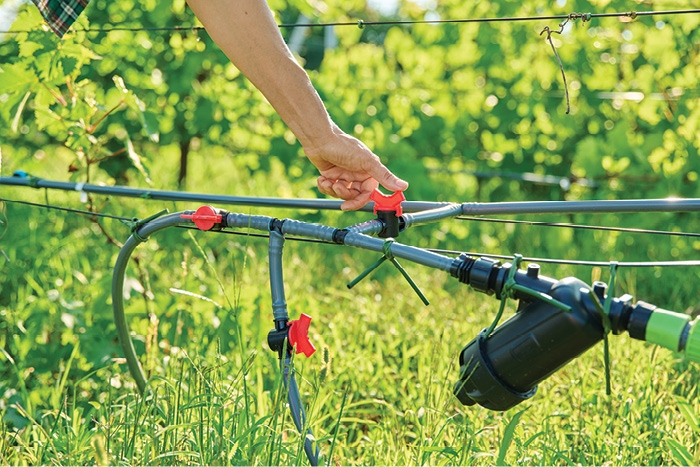
Deficit irrigation is an irrigation strategy that uses less water than a crop needs. The purpose is twofold. One is to help meet quality targets for production, and the other is to save water, according to Zaccaria.
“In Utah, tart cherries benefit from some deficit irrigation,” Yost says. “Fruit sugar content can increase with deficit irrigation, and it can reduce the risk of cracking at harvesting.”
Similarly, in almonds, pistachios and wine grapes, deficit irrigation can improve specific attributes the market rewards, such as higher feed quality in forage or improved sugar-acid balance in grapes, or higher degree of hull-split and shell-split in almonds and pistachios.
“In the context of California’s ongoing water regulations, limited groundwater extraction because of the Sustainable Groundwater Management Act of 2014 supplies, and increasingly variable surface-water supplies, deficit irrigation takes on an even greater practical importance for producers,” Zaccaria says.
Since agriculture accounts for 70%–80% of global water usage and water scarcity is a growing concern, deficit irrigation can be a strategy to consider. However, it’s not a perfect science yet, and there is some disagreement on the water-savings aspect.
“When you have limited water supply, not enough to fully [irrigate] to meet potential plant water requirements or to achieve maximum crop yield, deficit irrigation is a benefit … .”
— Daniele Zaccaria, PhD, professor of agricultural water management, Cooperative Extension, University of California, Davis
“Water savings from deficit irrigation is complicated and a little bit controversial,” says Zaccaria. “There is a lot of emphasis on the topic, but the water savings hasn’t been quantified.”
Zaccaria added that after one or two seasons of water-supply restrictions, either due to physical droughts or to stringent regulatory limitations, producers must apply extra water during the offseason for leaching salts that may have been accumulating in the soil root zone.
“The need of salt leaching is often forgotten or overlooked by water regulators, and the need of extra water for leaching is often not accounted for when calculating the real water saving of deficit irrigation practices,” he says.
Intentionally using deficit irrigation has the potential to increase market value and slightly reduce crop yield while increasing market value. The benefits vary by crop and largely depend on timing and level of water deficit.
Below are several (but not all) examples of how deficit irrigation can improve outputs in different crop types:
In addition to enhancing specific market-desired traits, having some or even limited water is better than severe or complete crop loss.
“When you have limited water supply, not enough to fully [irrigate] to meet potential plant water requirements or to achieve maximum crop yield, deficit irrigation is a benefit, because you can still attain marketable yield and profitable crop even without a full water supply,” Zaccaria says.
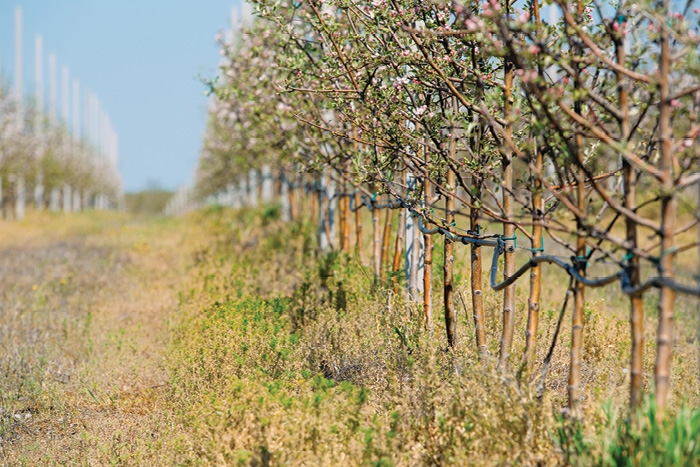 Timing deficit irrigation is crop- and situation-specific. Implemented at the wrong time, it can have a detrimental impact on yield and quality. Start by understanding crop-specific water needs and crop yield response to water. (The Food and Agriculture Organization of the United Nations publishes this type of data.) Then, get knowledge about plant growth stage.
“When the plant is getting ready to produce the seed, the grain, that’s a really sensitive time,” Yost says. “If you deficit irrigate, then it disrupts that. It causes significant loss to the grain production. If implemented in the earlier states of growth, the plant can handle some level of stress.”
All crops have sensitive and nonsensitive stages related to water stress. The key to deficit irrigation is identifying when mild stress will have the least impact, or even a positive effect. Consider the impact at the following stages:
Knowing the crop’s end goal is also critical to define the more suitable water management strategies.
“Look at the timing of your water availability before you put a crop in the ground,” Yost says. “If you know you’re going to run out of water in the middle of the season, in June or July, then you plan accordingly.”
Relying on visual cues to determine whether a crop is receiving too little water is not recommended. By the time plants show signs of stress, such as stunted growth, rolled leaves or shriveled leaves, it may be too late to reverse course. Weather stations that help estimate evapotranspiration (ET) rates and soil-moisture monitoring to track soil-water status provide more accurate reflections of the plants’ water status and stress.
When monitoring soil moisture, the key is to keep it between field capacity and permanent wilting point. “You don’t want to get too close to wilting point when deficit irrigating, because you can never get back,” Yost says. “For a lot of crops, you can deplete about 50% of the available soil water before you need to start filling it back up again.”
“You don’t want to get too close to wilting point when deficit irrigating, because you can never get back.”
— Matt Yost, PhD, interim head, Department of Plants, Soils & Climate, Utah State University
Heavy clay soils that begin to crack also indicate crops are receiving too little water. If this occurs when using sensors, there might be a sensor disconnect from the soil particles. This may provide misleading or erroneous soil-moisture readings, which could lead to severe plant stress, according to Zaccaria.
He adds that a lot of growers in California use a combination of irrigation methods (plant-based, ET-based and soil moisture-based) to deliver precise amounts of water to maximize plant health and yield while reducing total water usage, or to achieve and maintain desired plant water-stress levels.
“Micro-irrigation is common in the western U.S., allowing precise delivery of water and nutrients (an added layer of complexity),” Zaccaria adds. “Without attentive calibration, it’s easy to over- or under-irrigate, risking crop loss either way if these situations occur during crop stages sensitive to water stress. The greater the crop’s value, the greater the risk and the more critical precise water management becomes.”
Using deficit irrigation successfully is a learning process and requires a great deal of knowledge and skill. Yost suggests using the Utah State University Crop Resource Extension‘s “Strategies for deficit irrigation of forage crops” article, and Zaccaria recommends the Journal of Experimental Botany‘s “Deficit irrigation for reducing agricultural water use” as a resource for understanding the fundamentals of deficit irrigation and reducing agricultural water use.
“There’s a lot of information growers need before they are ready to implement these irrigation strategies — not just the farm manager, but the irrigators in the field,” he says. “I was part of a deficit-irrigation trial on processing tomatoes, and it took three PhD scholars left alone working on the trial, and they could not trigger deficit on our deep clayey soil for two consecutive seasons. There is a lot of stuff that happens in a grower’s field that makes it even harder, so deficit irrigation is a good principle but not easy to implement.”
When not implemented well, it can have an adverse effect on crop yield. “I’ve seen cases where farmers have tried to cut back; they tried to deficit because they expected some shortages, and then the shortages didn’t happen,” Yost says. “Somehow they had extra water, and they lost production that they could have otherwise had.”
His advice: Use the water you have. “If you have the water and can’t store it, use it, because there can be so much uncertainty for the rest of the season,” he says. “In other cases, if you’re going to be a little bit short all season long, then deficit irrigating a little bit all season can be a great strategy to keep production going all year. Planting less acreage is another option.”
Despite the challenges of using deficit irrigation, it is a strategy that can yield significant benefits, especially during times of drought and regulatory water-supply limitations.


