In 2024, a major weather event was reported in the United States every four days, according to the International Institute for Environment and Development. That figure doesn’t include nonweather-related events such as toxic spills or train derailments, which might be less frequent for growers in rural areas but are still a real concern for agricultural irrigators in some locations.
When a major disaster strikes, growers face not only the risk of expensive system repairs or replacements but also the potential for total crop losses. Irrigation systems cover less than 20% of U.S. cropland, yet they account for 50% of crop value, according to Alex Bracht, business development manager of groundwater for Franklin Electric. Bracht covers the Western U.S. and Canada.
“These systems are very valuable and essential to supplying food and fuel for the world,” he says. “I’ve seen fires, flooding, freezing temperatures, lightning storms, heat waves, high winds and more damage irrigation systems, which can cause downtime.”
Growers must address irrigation downtime in days, not weeks, to minimize impact on crop yields. Having a preparation and response plan in place can mean the difference between a profitable year and a very lean year.
Laxmi Prasad, PhD, an assistant professor and extension water engineer for North Dakota State University, breaks preparedness into three main areas: protecting critical infrastructure, developing contingency plans and strengthening communication networks.
“It’s critical to develop a plan and keep it simple so you can act quickly,” he says.
The first 24 hours may get the most attention, but disaster response often stretches far beyond the initial event. These six steps can help you prepare.
Many agricultural irrigators underestimate their exposure because they don’t see themselves in the classic hurricane, tornado, flooding and wildfire narratives. Power outages can occur anywhere for a variety of reasons — even extreme heat can knock out power from overuse. Do you have a plan for protecting sensitive electrical components and a backup energy supply to keep the system running?
Start by identifying the hazards and risks most common to your region. Define how these scenarios can affect your business using the business impact analysis on the Ready.gov website. The BIA provides a step-by-step approach for assessing your risk.
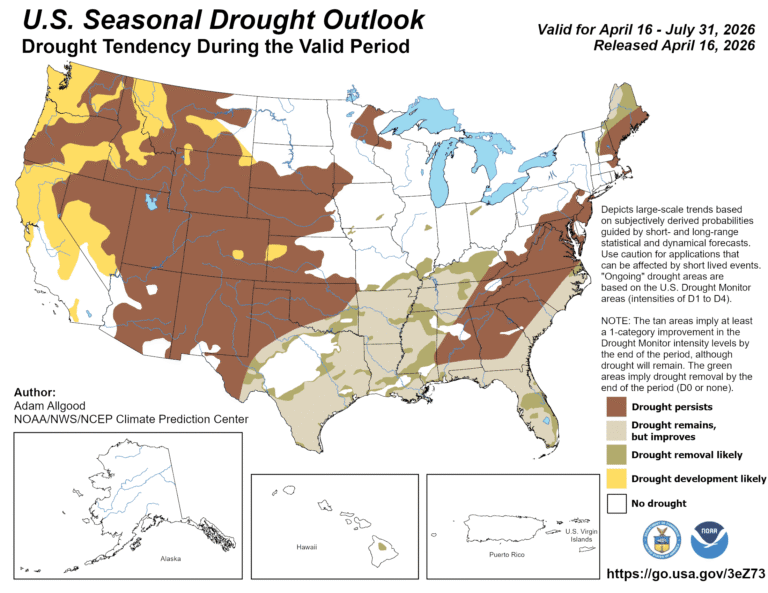
For producers in the Western U.S., growers and irrigation professionals should be thinking about how snowpack levels affect water availability.
“If at all possible, find resources that provide advanced indicators to water availability, such as water supply forecasts and snowpack levels,” says Brian Domonkos, the Colorado snow survey supervisor for the U.S. Department of Agriculture Natural Resources Conservation Service.
Conversely, high snowpack combined with other conditions can create flooding issues, so it warrants monitoring conditions and weather forecasts.
Irrigators in some states can use National Water and Climate Center maps — in Colorado’s case, an interactive map — to monitor current snowpack levels (scan the QR code).
“Irrigators should find a streamflow point on the map that is either directly linked to a stream they source from and/or one that closely correlates to their stream,” he says. “This will provide the best indication of anticipated water availability.”
It’s important to remember that water-supply forecasts consider total volumetric runoff for the given time period, often several months, in an effort to give an idea of the probability of runoff scenarios. There are a range of runoff possibilities, expressed in exceedance forecasts, to assist irrigators in understanding different possible scenarios based on current conditions and potential future weather, he explains.
“Some simple statistics or data comparisons will go a long way to indicate how much water should be available to you,” he adds. “If you are interested in more resources, tools and data, reach out to NRCS for assistance.”
“It’s always good to understand the timeline to address the various components used in an irrigation system with the installer or supplier.”
— Alex Bracht, business development manager, groundwater, Franklin Electric
Risk assessment is only one piece of the equation. Another critical component is designing systems with severe weather events in mind. Bracht explained that small investments up front can significantly reduce long-term damage.
For example, he recommends installing:
Prasad agrees that much of the vulnerability in irrigation systems stems from electrical panels, pumps and controllers. In addition to surge protection, he recommends proper weatherproofing, protection against sedimentation and elevating equipment out of potential flood areas.
“Make sure the control panels and pumps are well grounded, and frequently check for loose or exposed connections,” he says. “Pay particular attention to those components after nongrowing seasons, when rodents, snow and wind may have damaged wiring.”
The right combination of people, products and support structures can turn what might have been a season-ending event into a manageable setback. Key elements of a plan include:
One area producers often overlook is communication — both who to call and where to get timely information. Partnerships and coalitions help growers and irrigators stay informed and supported in making critical safety decisions for employees and in coordinating needed repairs.
“Many times that is something not on the forefront, especially when it comes to disaster preparedness,” Prasad says.
He suggested maintaining an updated contact list of key personnel and agencies, including USDA disaster resources, local extension offices, Farm Service Agency personnel, NRCS staff and irrigation district contacts.
“Many times, local extension officers might be surveying the damage and making these reports to the Farm Service Agency or arranging resources for producers that have experienced significant damage in these disasters, so you want to strengthen your network,” he says.
Once the storm has passed, it can be tempting to rush out and check the system. However, your personal safety and your employees’ safety must come first.
“Make sure the power is shut down to the system so that any safety hazards are reduced significantly,” Prasad says.
Then, thoroughly document all damage with photos, videos and notes. Report the damage to your insurance provider immediately and connect with the appropriate service professionals (electricians and irrigators) to discuss repairs. Also report damage to local disaster-related offices, such as NRCS, the FSA and local irrigation districts.
“The steps to assess the damage vary widely by component and the event that caused the damage,” Bracht said. “Generally, manufacturers will have processes to test electrical and mechanical equipment, and it’s always best to have a professional conduct these tests, as they often receive specialized training through suppliers and the manufacturers they work with.”
Prasad also recommends prioritizing repairs based on crop stage. If the storm occurs at the end of a growing season and irrigation is not needed, it likely is possible to strategically plan repairs, especially the more expensive ones, to spread the cost.
“A timely and well-documented response will help producers get back to full operating capacity faster, reducing the risk of yield loss,” he says.
In a large-scale event — such as regional fires, floods or storms — many systems in the same area might be damaged at once. That puts pressure not only on service providers but also on inventory pipelines.
“It’s always good to understand the timeline to address the various components used in an irrigation system with the installer or supplier,” Bracht says. “You can compress this timeline by selecting products that are stocked and serviced locally by installers and suppliers. Furthermore, you can select products stocked domestically by manufacturers, as one natural disaster may affect many systems in a single area.”
With ongoing global supply chain unpredictability, relying on components that must arrive via long-haul cargo or international shipments can introduce delays of weeks or even months. For a grower, that can mean missing a critical irrigation window entirely.
Disasters rarely arrive when it’s convenient. Some weather conditions give time to react, but others do not. Through thoughtful preparation and the right partnerships, growers can better protect their irrigation systems and their crops when the next disaster strikes.
3030 Clarendon Blvd. | Suite 300 | Arlington, VA 22201
Tel: 703.536.7080 | Fax: 703.536.7019
HOME | ABOUT US | ADVERTISE | SUBSCRIBE | CONTACT | PRIVACY POLICY | IA ANTITRUST STATEMENT