For growers and irrigation professionals, many federal acronyms compete for attention. But if you work with irrigated agriculture, whether you farm, design systems, sell equipment or provide consulting, one program belongs at the top of the list: the U.S. Department of Agriculture and Natural Resources Conservation Service’s (NRCS) Environmental Quality Incentives Program, more simply known as EQIP.
EQIP is often the difference between a good idea on paper and a shovel-ready project in the field because it pairs technical assistance with cost-share support for upgrades that improve water management, production, efficiency and overall resource stewardship.
This year, EQIP policy is moving on several fronts at once. The Irrigation Association is working to keep the industry informed and to engage in the process so irrigators’ needs are communicated to decision-makers.
The NRCS describes EQIP as a voluntary program that provides technical and financial assistance to help agricultural producers increase production and address natural resource concerns on their land. It achieves this through a wide range of practices. Baseline funding in recent years has been around $2 billion, with temporary increases under the Inflation Reduction Act.
Focusing more narrowly on irrigation, roughly $150 million to $300 million annually has gone toward irrigation and irrigation-related practices out of total EQIP funding, based on IA analysis of federal data. Because EQIP typically covers up to 75% of estimated practice costs for most participants, that federal support leverages additional producer investment. In practical terms, $150 million to $300 million in EQIP irrigation payments can support roughly $200 million to $400 million in total on-farm irrigation work once producer cost share is included.
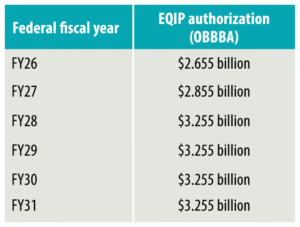 How the OBBBA reshapes EQIP funding
When the One Big Beautiful Bill Act (OBBBA) was passed and signed into law in July 2025, it made changes to EQIP funding levels. The act did this by rescinding near-term supplemental funding and increasing the baseline through federal fiscal year 2031. Given challenges to NRCS staffing levels and slowdowns in EQIP project implementation, somewhat lower funding levels in the near term and higher levels in the long term match well with business and administrative realities. The funding levels from the OBBBA are outlined in the table above.
The bottom line is that EQIP funding has a clear runway for the next six years with historically high baseline funding levels, and the share used for irrigation practices is likely to grow.
A major near-term question is how EQIP payment limits will work going forward after recent legislation appears to have removed the prior multiyear “lifetime of the Farm Bill” aggregate cap that many producers planned around. Nonetheless, the regulatory per-contract limit appears to remain in place as of February. Producers and their partners need clear, consistent direction on what the NRCS will do for FY 2026 and beyond, whether through rulemaking, guidance or another approach, and when states and applicants should expect it. For irrigation, this directly affects how producers scope whole-system projects that include pipelines, pumping plant work, sprinkler conversions and irrigation water management, and whether projects can be built as one integrated package or must be phased.
Even when funding is available, irrigation projects stall without technical services such as planning, design, documentation and verification. The NRCS’s Technical Service Provider (TSP) program is one of the best levers to increase capacity by enabling qualified third parties to support conservation program delivery. The IA expects to move forward this spring with an NRCS memorandum of understanding to leverage IA agricultural irrigation certifications and streamline the pathway for certified professionals in pilot states. The IA anticipates a summer launch in Arizona, California, Nevada and Utah, with plans to roll out to additional states based on results. The practical goal is to reduce friction, strengthen applications and help ensure projects are ready to go when signups open and contracts are awarded.
EQIP funding has a clear runway for the next six years, and the share used for irrigation practices is likely to grow.
The NRCS generally requires land to have been irrigated in two of the last five years for certain irrigation-related water conservation improvements. In the field, irrigation history can be interrupted for reasons that do not reflect a producer’s long-term irrigation needs, including water supply disruptions, crop rotations, ownership or operator transitions, and major repairs. Furthermore, growers may want to expand irrigation in areas where water is available, which, if done efficiently, is consistent with EQIP’s purpose of increasing production while conservating natural resources.
The NRCS has a waiver pathway, but it is narrow, limited to certain categories of applicants and routed for national approval. The IA is exploring what a more permissive waiver framework could look like, potentially allowing waivers where the upgrade delivers especially strong efficiency gains or where local water scarcity is not the limiting factor, so the rule supports conservation outcomes without blocking sensible modernization. We also hear that some producers try to work around the requirement by installing low-cost, inefficient equipment first and then apply after two years of irrigation history. While the IA does not recommend that approach, it is a reality, and a better policy solution is needed.
EQIP typically pays using standardized payment schedules based on estimated costs, not invoices. That keeps administration manageable, but it also means the effective cost share depends on how closely schedules track market conditions. For irrigation, that gap can be significant when prices move due to steel and plastics, trenching conditions, pumps and motors, energy controls, and retrofit complexity, including MDI, VRI, nozzle and drops retrofits, and other common upgrades. The IA is exploring how to encourage better alignment in more places through more precise practice scenarios and more timely updating of key cost components, so payment rates reflect real-world installation costs and projects pencil out reliably for producers.
The OBBBA sets EQIP funding levels through FY 2031, providing a clearer funding runway than irrigators have had in years. Turning that runway into installed irrigation improvements will depend on strong program implementation. The IA will continue working with NRCS, state offices and industry partners on each of these areas, with the goal of helping irrigated agriculture compete successfully for EQIP support and use it effectively in the field.