Standards are tools that enable us to make order in a messy world. Data exchange in agricultural irrigation has been particularly messy with growers and manufacturers having to deal with multiple data formats. The American Society of Agricultural and Biological Engineers/American National Standards Institute National Standard S632 for the exchange of irrigation data helps to solve this issue by providing a common model and format for data that drives irrigation decisions.
Data exchange in agricultural irrigation has been particularly messy with growers and manufacturers having to deal with multiple data formats.
The existence of such a standard is only a first step, though; its value is only realized through implementation.
Two ag industry companies recently tested the implementation of S632 Part 2, which deals with observations and measurements data. It is an agricultural implementation of the International Organization for Standardization 19156 standard, a conceptual model for observations and measurements. One company was the data producer and the other served as the data consumer.
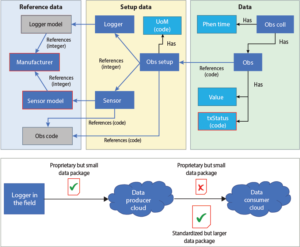
The basic data model is shown in fig. 1. It includes reference data describing the manufacturer’s equipment, setup and configuration data at the farm site, and the actual measurements (“Obs” in fig. 1). The first task was to translate the data coming in the data producer’s proprietary format to the S632 standard format. This was a fairly straightforward task.
The second, and very important, objective was to preserve the meaning of the data during the translation. Codes from the data producer’s system were reformatted to standardized observation codes. The team explicitly declared the units of measure in the S632 format, using a standardized code list from AgGateway’s ADAPT framework.
The data producer, like many manufacturers, sends a very compact data set from the logger to its cloud server. These small packets sometimes encode errors or other metadata into unused data values. This was carefully decoded as the data moved from the data producer’s cloud server to the data consumer’s cloud server (see fig. 2) to make the data original equipment manufacturer-agnostic. The integration team did this by using rules to tease out the different kinds of information contained in the original data packets and separated them into explicit S632 data-type “bins.”
The data producer found value in this integration test, as it sees a growing demand for standardized data, and standardization provides their sales force increased compatibility with other systems, an important point of value. Open data standards are also valuable to growers, by simplifying their workflow and shrinking the number of dashboards they must use.
From the data consumer’s perspective, standards-based data integrations scale better and have easier maintenance than myriad point-to-point efforts. A centralized system can periodically fetch data from multiple sources and store it in a common format.
Both companies found that implementing the standardized data integration was not an arduous task, provided the existence of documentation. A well-structured standardization effort affords the opportunity to accurately preserve the meaning of the exchanged data, helping companies help growers make informed irrigation decisions.