The irrigation industry has reached a tipping point in managing agricultural and horticultural systems. According to industry insiders, the “set-it-and-forget-it” days of water management are over. Water is not only a highly coveted and regulated resource, but growers simply lack the boots on the ground — or in the greenhouse — to manually oversee older delivery systems.
To keep operations viable, whether the crop is corn, cotton, tomatoes or petunias, irrigation professionals must pivot their focus to help growers transition from traditional water movers to expert data managers.
Don Cameron understands firsthand the pressure to manage a highly regulated resource such as water, along with other economic hurdles, just to stay viable. He’s vice president and general manager of Terranova Ranch, a 6,000-acre diversified growing operation based in Helm, California, that specializes in more than 25 conventional and organic crops, including nuts, tomatoes and wine grapes. The farm is widely recognized as a leader in sustainable practices and water conservation.
“In California, we have pressure with sustainable groundwater management,” Cameron says. “As far as groundwater pumping throughout [California], the estimate is anywhere from half a million to a million acres [of crop land throughout the state] will have to be taken out of production by 2040. So, we have a lot of pressure here to conserve every drop of water.”
Terranova began converting to subsurface and surface-drip irrigation systems in 2009, giving the farm a significant financial advantage over growers who were slow to adopt the technology. However, Cameron recognized that manual irrigation management, requiring around-the-clock labor crews to open and close valves, was inefficient, unsustainable and prone to human error, often leaving Terranova’s fields either oversaturated or dehydrated.
He sought an automated solution that avoided the bulky solar towers in fields and battery dependencies of traditional systems, instead prioritizing a flexible system capable of operating within the 130-day crop cycle of the farm’s specialty crops.
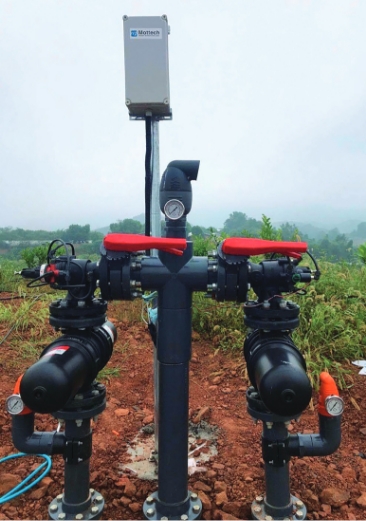
Wanting a cloud-based system, Cameron collaborated with a local internet provider eager to gain traction with local growers. Together, they integrated off-the-shelf controllers with a long-range wide-area network, a networking protocol for the Internet of Things that allows battery-powered sensors to communicate small amounts of data over long distances. This communication network, running since 2022, was a perfect fit for Terranova’s monitoring needs and provided the foundation for a custom dashboard that allows Cameron and his team to manage the farm’s irrigation strategy with high precision.
“All of a sudden, we became very precise in what we were doing,” Cameron says. “Sure, we had some issues early on with valves not working properly, and we blew a few lines … all of the things that you’re going to experience putting a new system together.
“Being automated, we’re able to cut back on labor because now we don’t need [people] and vehicles to go around opening and closing valves day and night in over 30 fields of tomatoes,” he adds.
To ensure things keep running smoothly, Terranova utilizes a robust network of monitoring hardware. Flow meters and pressure sensors allow the team to analyze system performance in real time, providing the data necessary to identify declining well levels or mechanical inefficiencies before they impact crop health. This technical framework is strengthened by redundant monitoring systems. By partnering with external firms to correlate electricity consumption with pump-efficiency tests, the farm accurately calculates water extraction. Additional electromagnetic meters transmit real-time pumping data directly to the local Groundwater Sustainability Agency, which manages groundwater extraction in one of California’s critically over-drafted subbasins.
“We’ve noticed that we can cut back on the water that we have been using because we’re more accurate and know exactly how much water has been put on each field,” Cameron says. “At the end of the year, we look at the water used, and we look at the yields we’ve generated by that water. And we’re becoming much better managers of a resource that is becoming more expensive and in short supply.”
Over time, modern farms have grown exponentially. The picturesque notion of the small family farmhouse, centered among fields of crops, is no longer realistic. As the scope of the average agricultural operation has grown, so has the grower’s fragmented footprint, often dotting the countryside across multiple counties and states.
While modern irrigation’s agronomic benefits are significant, perhaps the most impactful shift is its ability to address and mitigate labor and geographical constraints. Similar to Terranova, today’s growers lack the financial and personnel resources to deploy experts to remote-control boxes to open and close valves and oversee expansive irrigation operations.
Instead, smart systems and automated controls centralize irrigation management, allowing a lean team to monitor diverse sites remotely, says David Peters, North American business development manager at Mottech Water Management, based in Aubrey, Texas. Mottech provides remote monitoring and control solutions for agricultural and landscaping irrigation.
A shift to modern irrigation systems enables growers to scale their operations without being restricted by physical proximity, Peters says. Further, these systems allow growers to reassign their labor resources from manual irrigation oversight and system checks to more essential duties, such as crop cultivation and plant health, he adds.
“Being automated, we’re able to cut back on labor because now we don’t need [people] and vehicles to go around opening and closing valves day and night in over 30 fields of tomatoes.”
— Don Cameron, vice president and general manager, Terranova Ranch
“We’re seeing [growers] trying to do more with less,” Peters says. “[Irrigation smart systems] open up the options for a business to grow and get larger and not just be geographically limited to where they are because they don’t have the resources, staff-wise, to have somebody at every location [overseeing irrigation duties].”
Beyond simple watering schedules, modern technology integrates the entire distribution chain, including monitoring well levels, pump pressure, and hardware performance. Without remote access, Peters says, growers are forced to rely on infrequent “snapshots” of data collected during costly time- and labor-intensive site visits. By replacing manual inspections with soil moisture sensors and cellular connectivity, a grower replaces guesswork with precise, remote-controlled oversight.
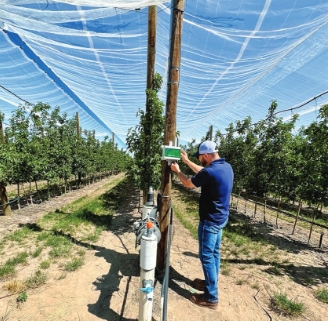
“Is the irrigation system distributing water like it’s supposed to be, and then what’s happening with that water in the ground?” Peters says. “Now you’re able to monitor [crops] without physically having somebody drive 50 to 100 miles to go look at it. Without it, for the grower, it becomes a juggling act of whether they spend the money on manpower and fuel to go out to [crop sites] firsthand, or do they put the money into technology that gives them eyes and ears from a remote location and a better, more accurate idea of what’s going on with the plant material?”
Another real-world example, according to Peters, is the critical role remote irrigation management technology plays in assessing the extreme variability of localized weather. A light rain at one crop site might coincide with a deluge just miles away, making automated, real-time data essential for preventing unnecessary irrigation, he says.
“I just got a half-inch of rain here in Dallas,” Peters says. “In Central Texas, we received 6 inches of rain overnight. There’s no need for any irrigation down there … they’d be underwater.”
Integrating smart irrigation technology isn’t exclusive to traditionally parched growing regions. Washington State University’s Lav Khot, PhD, professor of precision agriculture in the College of Agricultural, Human and Natural Resource Sciences’ Department of Biological Systems Engineering, says the Pacific Northwest historically has enjoyed stable water availability. However, diminishing mountain snowpack has thrown this equilibrium out of whack, leaving fruit crop growers without the water needed for soil irrigation and tree canopy cooling.
“The issue now is there’s less water available overall,” Khot says. “There was either reduced or no surface water coming to the canals in Central Washington during 2025 summer months, and there was nothing to irrigate with.”
To address the irrigation water shortage issue in peak summer months in fruit crop production, Khot says WSU researchers and private vendors collaborated to form the Smart Apple Orchard Testbed project, with funding from the Washington Tree Fruit Research Commission, to pilot automated irrigation driven by soil, plant and weather data. The effort demonstrated significant improvements in water efficiency, fruit quality and profitability. Key results from the 2024 and 2025 harvests showed that data-driven, automated irrigation technologies could reduce water usage between 20% and 52% while increasing growers’ gross packout thanks to reduced fruit-storage disorders.
While many Washington fruit growers traditionally relied on general data from open-field weather stations to calculate their evapotranspiration rates, there is a measurable migration toward site-specific technology, Khot says. Survey data show that more growers are deploying sensors to collect soil-moisture data and using climatic models for irrigation scheduling or sensing canopy/fruit temperatures to cool them on peak heat-stress days. Khot says this shift reflects growers’ commitment to precision irrigation in response to seasonal weather volatility and uncertainty.
“Precise water delivery is the foundational element that ensures [apples] reach their desired size, color and health,” he says. “This necessity for precision [irrigation] extends beyond apples to other high-value crops in Central Washington, including wine grapes and blueberries, which face identical threats from water shortages and thermal stress.”
Modern agronomics isn’t exclusive to the nation’s Corn Belt. Substantial agricultural and horticultural operations take place under cover in controlled-environment agriculture, or CEA. In addition, nurseries and greenhouses produce vast quantities of ornamental plant material, including shrubs and trees, that support the residential and commercial landscape industries. All of these growing environments are substantial water users, and all benefit from smart irrigation systems.
There is significant untapped potential for irrigation automation within the nursery industry, says Amy Fulcher, PhD, an extension specialist and professor for sustainable ornamental plant production and landscape management at the University of Tennessee’s Department of Plant Sciences. Her 2024–2026 research focuses on bridging the gap between advanced smart irrigation technologies and practical adoption in ornamental greenhouse and nursery environments.
“We looked at the nurseries using [automated irrigation systems], and it’s low-hanging fruit,” Fulcher says. “There are lots of opportunities for [nursery growers] to adopt this very basic, very affordable, not-complex technology.”
There’s a paradox with smart irrigation systems and today’s nursery growers. Fulcher says her team explored why roughly 69% of nurseries use automated irrigation controllers, a figure that has plateaued over the last 15 years despite the industry’s critical labor shortages.
Smart irrigation technology, such as timers ranging in price from $200 to $2,000, is a negligible cost, according to Fulcher, when compared to heavy machinery like potting machines, which can cost $100,000. In fact, according to her data, around 44% of irrigation tasks across the industry are still performed manually. This reliance on manual labor persists despite the inefficiency and potential for human error of manual irrigation systems.
The benefits of transitioning to new technology are multifaceted, particularly in terms of labor efficiency and resource conservation. According to Fulcher, a small-scale automated irrigation system saved a wholesale nursery in Knoxville, Tennessee, between 3.3 and five hours of labor every other day. In this specific operation, which employed only a handful of workers, the owner had spent 12 hours a day manually opening and closing valves through 30 irrigation zones. Fulcher says her research suggests that the greatest benefit of employing smart irrigation technology isn’t labor costs, but rather the opportunity to redirect labor to higher-value tasks, such as pruning and pest mitigation.
“Is the irrigation system distributing water like it’s supposed to be, and then what’s happening with that water in the ground? Now you’re able to monitor [crops] without physically having somebody drive 50 to 100 miles to go look at it.”
— David Peters, North American business development manager, Mottech Water Management
“Typically, irrigation can be 9% to 10% or so of labor, so not an insignificant amount,” Fulcher says. “And it’s one of those repetitive things you’re doing again tomorrow and the next day and the next day and the next day. So, if you can get something repetitive like that automated, it can really save you a lot on labor, and it can lead to more fulfilling job opportunities for your employees.”
The evolution of smart irrigation technologies relies heavily on data from an unprecedented variety of sensors capable of collecting high-level data to monitor soil and plant health.
Washington State University’s Lav Khot, PhD, professor of precision agriculture in the College of Agricultural, Human and Natural Resource Sciences’ Department of Biological Systems Engineering, believes the continued shift toward data-driven agriculture will heighten grower awareness of the value of data ownership and the necessity of rigorous system upkeep. This is an area where machine learning and AI could help make irrigation decisions more precise.
“As long as you’re collecting good, meaningful data [from sensors in the field], then the machine learning and AI would just develop the schedules that you need to look at and activate block-specific control systems,” he says.
The industry has long possessed the algorithmic foundations for such automation, and Khot believes connectivity has been the historical bottleneck. The emergence of robust high-speed, low-latency wireless and satellite networks is bridging the gap between computational intelligence and field-level controllers.
As these connectivity barriers continue to dissolve, Khot says the promise of refined, “brilliant” AI-driven irrigation management becomes a practical reality for the modern grower.