
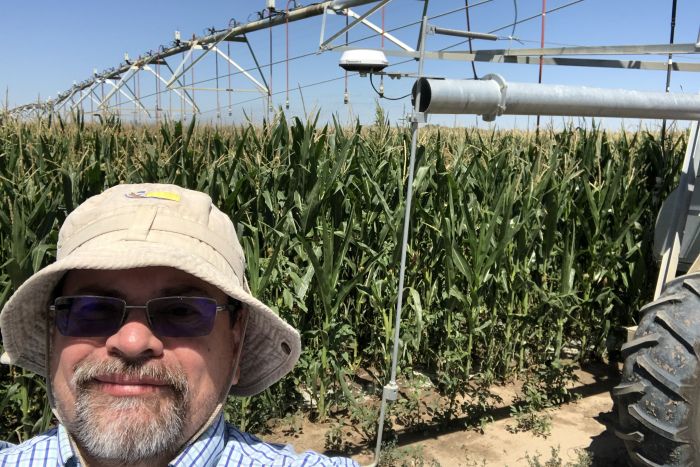
Growing up in the eastern lowlands of Bolivia, José L. Chávez, PhD, spent time working on his grandfather’s farm throughout his childhood. He recalls many fond memories of the countryside and horses, but he also remembers the challenges caused by extreme weather. At one point, his grandfather had to sell half the farm to pay creditors. Watching his family navigate the good and difficult times sparked his passion for irrigation, water management and conservation.
“So often farmers are at the mercy of nature,” he said. “That compelled me to pursue an engineering career in water management and focus on irrigation and drainage.”
Today, Chávez is a professor and extension irrigation expert at Colorado State University, where his work encompasses teaching, research, service and in-field conversations with farmers. His irrigation expertise includes crop water management, irrigation scheduling, irrigation system efficiency and precision irrigation.
He also studies how emerging technologies, including how remote sensing and evapotranspiration modeling, can improve irrigation decision-making. During his doctoral research, he collected and analyzed data from sensors mounted on manned aircraft as part of a large project funded by NASA, involving multiple universities and research institutions.
Chávez’s influence extends beyond research and into the classroom, where he teaches and advises countless graduate students, visiting scholars and researchers, while actively connecting them to industry opportunities, professional societies and applied research experiences.
In August 2026, Chávez was named the Irrigation Association’s 2026 Excellence in Education Award recipient for his contributions to irrigation education worldwide and his ability to translate research into practical, real-world applications.
“I’m very honored to receive this award,” he said.
Here he shares his journey from his family’s farm to becoming a leading irrigation researcher and educator.
How did your education and early professional experiences shape your career?
Around the time I was graduating high school, a lot of funding was available for irrigation. I started at Universidade Federal da Paraíba in Brazil, where I earned a bachelor’s in agricultural engineering. Then, after a few years of working in the industry, I went to Utah State University for a master’s in irrigation engineering and earned my PhD in biological and agricultural engineering there too.
At the time, teams from Utah State were helping develop irrigation infrastructure and management globally, and I got more deeply involved in irrigation through hands‑on work. While there, I had the opportunity to go to the Dominican Republic to help with irrigation management there. I spent almost four years doing postdoctoral research, which included one and a half years at Washington State University in the Yakima Valley and two and a half years at Bushland, Texas, with the USDA Agricultural Research Service.
Today, my role at Colorado State University is a three-way appointment that includes teaching, research and extension work.
What drives your passion for teaching and working with the next generation of irrigation and water management professionals?
The success of the students who graduate from our programs. They get job offers quickly, even before graduating, and it is rewarding to see their success. I also enjoy involving students in research.
In addition to extreme weather conditions and declining water reserves, what other challenges need to be addressed?
Salinity. We are using remote sensing to detect salinity in irrigated fields and include that information in irrigation decision-making. It’s not just about how much to irrigate and when. We also need to consider the environment and soil sustainability. Salinity is becoming an issue in some parts of the world, including Colorado. For several years, we have had funding from the USDA, the National Institute of Food and Agriculture and the Colorado Water Conservation Board. The research includes using remote sensing and modeling and many faculty, students and collaborators are participating. But the aim of all this is to keep farmers farming. When soils reach a certain level of salinity, crops cannot grow or produce profitable returns, and farmers will have to replace them with more salt-tolerant crops. If we can identify and address salinity sooner, we can help farmers protect their soil and profitability.
Why is collaboration important to addressing water management?
In many places in the Western U.S. water is a precious resource. We need to continue learning and discussing how to better manage water. The Colorado River is drying up, and that affects many states and Mexico. Other river basins (as the South Platte and Arkansas) face similar challenges. I’m very grateful to be part of this community committed to learning, sharing knowledge and trying to push forward. I work with collaborators in Spain, Uruguay and Chile, and we complement each other.
Share on social media:
3030 Clarendon Blvd. | Suite 300 | Arlington, VA 22201
Tel: 703.536.7080 | Fax: 703.536.7019
HOME | ABOUT US | ADVERTISE | SUBSCRIBE | CONTACT | PRIVACY POLICY | IA ANTITRUST STATEMENT