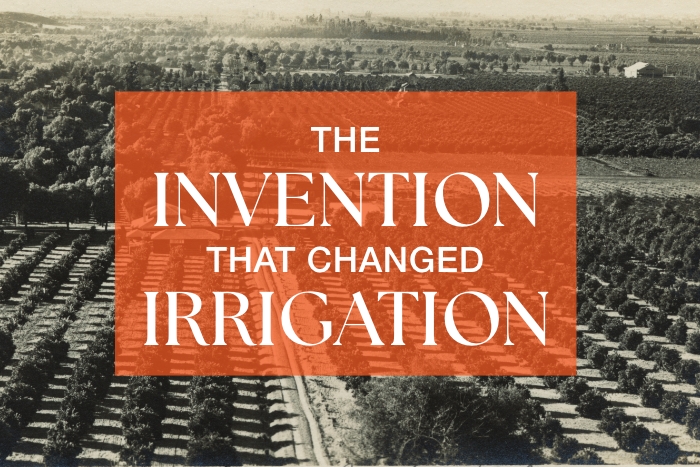
In a shed in Glendora, California, in the late 1920s and early ’30s, citrus grower Orton Englehart was hard at work, tinkering with pieces and parts, on a mission to find a better way to irrigate his orange grove. Everything from tin cans to whisk springs became reimagined and repurposed with one goal: devising a better, more efficient, more uniform method of delivering water to his grove.
“His intent was to solve a problem,” says Heidi Hanson, chair of the board of directors at Rain Bird Corporation. “I think he had an immense capacity [for] tinkering and engineering, and he focused it on something that could be helpful for his operation.”
Englehart did, in fact, create something inside that shed that would transform the way farmers delivered water to their crops: the impact sprinkler, which remains a big part of today’s agricultural irrigation toolbox. A patent for the impact sprinkler was filed on Dec. 18, 1933, and it was officially awarded on April 16, 1935.
Today, Rain Bird is committed to sharing the story of an ordinary guy who saw a problem and invented a solution that revolutionized the irrigation industry. According to Hanson, efforts to highlight Englehart’s contributions to irrigation stem from a desire to preserve an important piece of history and celebrate the spirit of innovation.
“We wouldn’t be where we are today without Orton, who made life easier for us,” Hanson says. “I’m sure there are crops we wouldn’t be able to grow as efficiently today without Orton’s invention. He made a big contribution to agriculture in this country because of what he did. Orton would never have wanted the industry to recognize him — he didn’t want anyone to recognize him — but I firmly believe it is important to do.”
As a child growing up in Glendora, Englehart was known as an introvert, and he was also known for his passion for citrus, something he could speak about for hours. Though Englehart was quiet and often secluded on his farm, he crossed paths with grower Clem LaFetra in the orange groves.
“Everyone helped everyone else when they were watering their crops in the orange groves,” says Hanson, LaFetra‘s granddaughter. “There was so much work that had to be done that everybody helped each other. The community came together to make sure everyone’s crops did OK. Clem and Orton knew each other because they were helping in each other’s groves.”
This connection between two men, opposite in many ways, would soon lead to the creation of Rain Bird and a means for Englehart’s impact sprinkler to eventually reach farmers worldwide.
“My grandfather made the decision to leave Glendora because there wasn’t enough money in growing citrus in his family’s grove to support his future family,” Hanson says. “He left and went into Los Angeles, and that’s where he became a salesperson, selling beekeeping equipment in the Central Valley. He met my grandmother, Mary, in Los Angeles.”
Though Hanson says Englehart never intended to sell his invention, LaFetra saw an opportunity for the impact sprinkler to positively impact farmers across the Central Valley.
“They needed Orton’s expertise in irrigation technology, my grandfather’s ability to sell it and my grandmother’s ability to keep the operations going. … It was always about how we can make people’s lives better and improve yields.”
— Heidi Hanson, chair, board of directors, Rain Bird
“Because Clem was going to the Central Valley to sell beekeeping supplies, he could spread the word about this sprinkler to other farmers, and Orton was OK with that because he liked helping the community,” Hanson says.
Using feedback that LaFetra brought back from farmers who were testing his prototype, Englehart would make tweaks to improve the design, says Mark Ensworth, director of research and development and chief engineer at Rain Bird. This process repeated itself for several years.
“There is a picture of the impact sprinkler at the time the patent was filed in 1933, and it was different from the prototype he was tinkering with in the 1920s,” Ensworth says. “He built a foundry next to his workshop, and you can tell he was using that foundry to cast some custom metal parts for the impact sprinkler.”
Englehart’s passion for problem-solving and the deliberate process of testing his invention, adjusting it and retesting it sheds light on his mindset.
“He was a citrus grower to pay the bills, but his real passion was inventing things and finding creative ways to solve problems, which is the mindset of engineers,” Ensworth says. “He made his prototype from a bunch of stuff you can buy at a hardware store, like sections of pipe screwed together and some sheet metal he cut with tin snips. It was very creative and it worked to solve the problem he was trying to solve.”
Though Hanson says Englehart never intended to sell the impact sprinkler, Clem and Mary LaFetra saw an opportunity to help farmers outside Glendora. With a patent in hand, Rain Bird was born, the impact sprinkler its first product.
“The three of them could not have started Rain Bird without each other,” Hanson says. “They needed Orton’s expertise in irrigation technology, my grandfather’s ability to sell it and my grandmother’s ability to keep the operations going. My grandfather was the guy next door, my grandmother was the female powerhouse, and all of them were so community-minded that it wasn’t about making money. It was always about how we can make people’s lives better and improve yields.”
Hanson says that before World War II, both Clem and Mary had full-time jobs. While Clem would collect orders during the week, the weekends were spent building sprinklers to fulfill the orders. Rain Bird didn’t become a full-time business until after World War II.
“They would be paying for the new materials out of the money they got from the orders they filled,” Hanson says. “Post-World War II, people needed jobs, there was money to invest and they opened a plant in Glendora with people from the local community working there.”
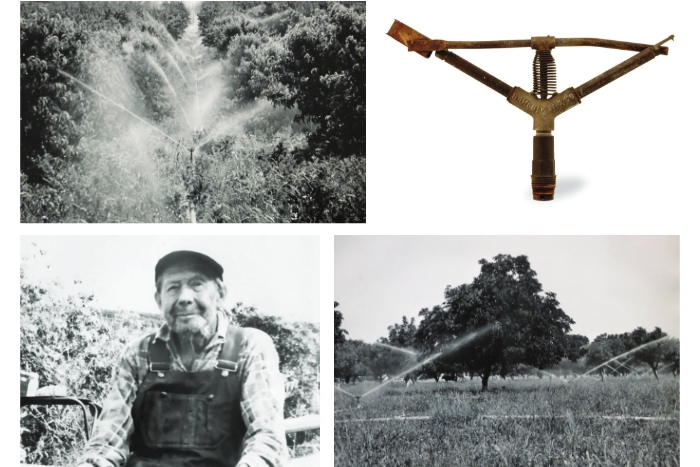
While irrigation product technology has expanded considerably since the invention of the original impact sprinkler, Englehart’s ingenuity has left a lasting mark on the irrigation industry.
“About 20 years ago, Rain Bird developed a whole new impact sprinkler that is very compact, with leading-edge technology, all based on the impact design,” Ensworth says. “We still sell that today. It’s quite popular for agricultural irrigation. In fact, with most of the sprinklers on the market today, Orton would know that it is an evolution of his design. It was 90 years ago when the impact sprinker was patented, and the design has not changed that much.”
At D’Arrigo California/Andy Boy, Production Superintendent and Pest Control Advisor Saul Lopez Jr. says the prospect of doing his job without the impact sprinkler is daunting for many reasons.
“Currently, I can assess more than 19 ranches knowing irrigation is consistent and reliable,” Lopez says. “Without impact sprinklers, daily routines would shift to constant irrigation troubleshooting, pulling time away from critical crop scouting, regulatory compliance monitoring and agronomic decision-making. Uneven water distribution would create hot spots and dry zones across fields, directly reducing marketable yields. For crops like broccoli and cauliflower, where head uniformity is critical, inconsistent irrigation would increase cull rates significantly.”
Lopez also says that the company’s commitment to farm water conservation and sustainable practices would be compromised, as less-efficient irrigation translates to higher water consumption per acre and increased runoff.
From a pest management standpoint, Lopez says he relies on precision irrigation scheduling to coordinate spray applications, fertilizer programs and disease prevention strategies. Without impact sprinklers, he says this coordination becomes impossible, and that would force a proactive crop management approach and his work to become reactive.
“Without impact sprinklers, we would revert to older, less-efficient irrigation methods like furrow irrigation, and we wouldn’t be able to schedule irrigation,” Lopez says. “When you irrigate that way, you can’t get your equipment in on time, because that type of irrigation heavily floods the furrow and keeps your equipment out.”

While the impact sprinkler has secured its place in the history books, Englehart’s shed is also being preserved both for the history it contains and the innovative, resourceful and creative spirit that it represents. In the ’90s, the shed was moved to Glendora’s Centennial Heritage Park.
“To be able to visit the place where a humble farmer from Glendora figured out how to make something that has made a huge impact on the irrigation industry and is sold all over the world today is really tremendous,” Hanson says. “Almost 100 years later, and we are still using concepts from that patent. Orton took something available on the market that worked fine and elevated it by controlling the movement of the water, enabling better distribution uniformity, and with this, significantly advanced the irrigation industry. That started a trend for how irrigation was going to evolve moving forward, and it changed the marketplace.”
As Rain Bird reflects on 90 years in business, CEO Mike Donoghue says that highlighting Englehart’s invention of the impact sprinkler and contributions to the irrigation industry provides a focus as the company looks toward the future.
“An important component of our mission is the ‘Intelligent Use of Water,’ and remembering that the company was founded based on an innovation in that pursuit has resonated with the employees of the company over the past few years,” Donoghue says. “It provides some context to what we do today and our focus for the future. Orton saw a need for more effective irrigation methods and applied ingenuity, creativity and diligence to the process of solving that problem. That spirit means a lot to the employees of the company and inspires their desire to solve the problems of today while looking to the future.”

Photos courtesy of Rain Bird Corp.