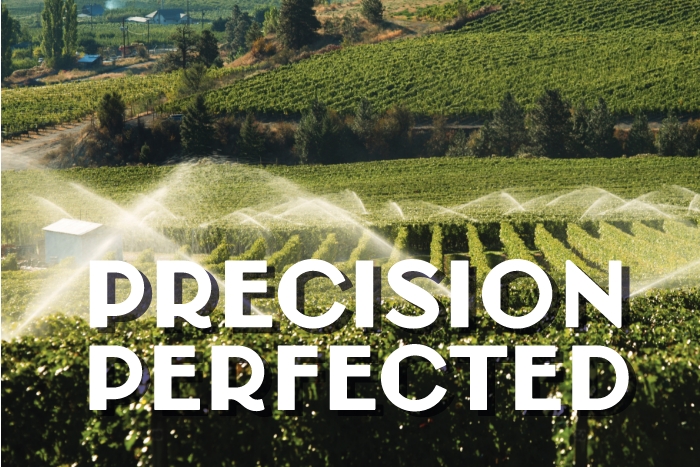
For decades, drip irrigation has been foundational to the evolution of precision irrigation, helping growers achieve efficiency and consistency at scale. Today, advances in automation, sensing and control technologies are expanding the precision toolbox, bringing renewed attention to modernized block irrigation systems. Once viewed as labor-intensive, block irrigation has evolved into a flexible, technology-driven approach that appeals to large-scale specialty crop growers looking to optimize operations while navigating labor constraints, water regulations and uniformity demands.
Specialty crop operations, such as vineyards and orchards, are highly sensitive to water stress. For example, a slight overwatering of wine grapes can dilute Brix levels (sugar content) and compromise a vintage, while underwatering almonds during hull split can devastate that year’s yield.
Traditional block irrigation setups attempted to address these risks by dividing a farm into manageable zones, each outfitted with dedicated valves to independently control overhead or micro-sprinklers. Historically, these block zones were technologically “dumb,” relying on set-it-and-forget-it or manual control systems that were labor-intensive and offered growers little to no feedback.
In contrast, modern block irrigation setups are light-years ahead, technologically speaking. They rely heavily on variable-rate irrigation, which leverages smaller management zones; data-driven, real-time decision-making; uniform plant health; and a high-tech infrastructure replete with smart valves, GPS mapping, satellite imagery, cloud connectivity, remote sensor management and, in some cases, AI guidance. So, instead of a one-size-fits-all approach, data dictates how water is dropped.
The shift toward precision block irrigation represents a critical evolutionary step, moving beyond simple water delivery, says Steele Roddick, senior digital marketing manager at Lumo, a Santa Rosa, California-based agricultural technology company that specializes in precision irrigation.
“By automating block-level management, [specialty] growers can maintain rigorous standards of crop health without relying on the constant physical intervention that traditional systems demand,” Roddick says. “Greater water efficiency is no longer just a matter of resource stewardship, but a necessary strategy for long-term viability.”
Modern block irrigation is the definitive future of sustainable agriculture, says Giovanni Piccinni, director of the Texas Water Resources Institute and a professor at Texas A&M University’s Department of Soil and Crop Sciences.
“Today, we have a lot of opportunities through remote sensing to really do precise block — or variable-rate — irrigation,” Piccinni says. “We have the ability, through satellite [imagery], drones and other applications, to get [real-time data]. And in doing so, you can really see the variability that exists in the field. So, irrigating based on the variability that the crop is experiencing is really a way to optimize water resources and is a way to really make sure that you are providing the crop with the amount of water that is needed for optimum yield.”
“[B]y partitioning a [specialty crop field] into distinct blocks, growers can tailor water delivery to match the precise moisture-holding capacity of the soil and the actual demands of the crop.”
— Giovanni Piccinni, director, Texas Water Resources Institute, and professor, Department of Soil and Crop Sciences, Texas A&M University
While the technical application of modern block irrigation is feasible across various platforms, including surface, sprinkler, pivot and drip systems, Piccinni says its true value lies in its superior efficiency and adaptability to specific crop needs. This is particularly critical in regions such as his home state of Texas, where the stark hydrographic divide at Interstate 35 separates the arid west from the humid east. In an era marked by the rapid depletion of groundwater aquifers, Piccinni says transitioning to high-efficiency block systems represents a vital strategy for resource conservation and advanced water management.
“Agricultural plots are rarely uniform,” Piccinni says. “Instead, they consist of diverse soil compositions that retain and release moisture at different rates. Treating an entire field as a single unit by applying a uniform inch of water inevitably leads to both waste and crop stress.
“But by partitioning a [specialty crop field] into distinct blocks, growers can tailor water delivery to match the precise moisture-holding capacity of the soil and the actual demands of the crop,” he adds. “This targeted approach ensures that water application correlates directly with crop water use, thereby maximizing yields while minimizing environmental impact.”
Modern automated block irrigation significantly alters the labor dynamics of specialty crop production by eliminating the repetitive manual tasks traditionally required for water management.
Roman Kozak, chief technology officer and co-founder of Verdi, a Vancouver-based precision irrigation firm, explains that traditional drip irrigation systems are inherently constrained by infrastructure limits. Because most farms lack the pumping capacity to irrigate an entire property simultaneously, growers must divide their land into discrete zones.
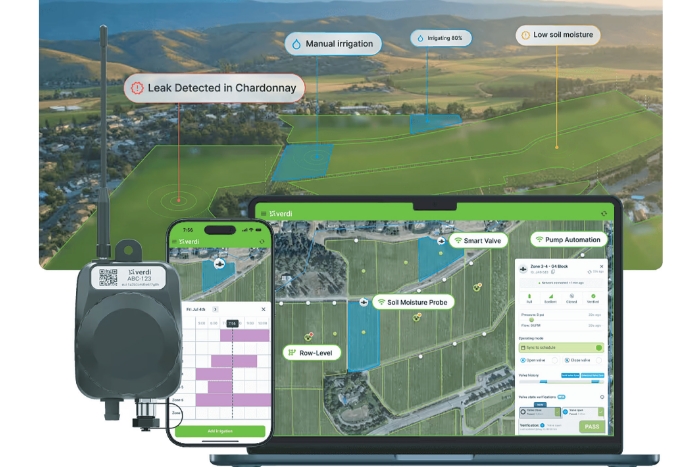
Without automation, this process requires irrigation personnel to remain on-site for more than 10 hours a day, manually cycling valves on and off every few hours. By implementing an automated system, Kozak says, growers eliminate this oversight. The technology manages the complex scheduling of pump and valve activation across various zones, freeing growers to redeploy that labor to other critical areas.
“There is immediate [return on investment] on labor savings,” Kozak says. “The day you install the system, you’re going to spend significantly less time turning things on and off and checking for leaks and breaks.”
For instance, Kozak says, in a merlot vineyard, the typical block requires irrigation once or twice weekly and a single operation may manage anywhere from 20 to several hundred such blocks. Data suggests a modern block irrigation system can save one hour and 20 minutes per irrigation event for a single block of grapes.
“We see farms being able to now be more productive because they can have those people doing higher-value tasks,” Kozak says. “So, if you had 10 people previously on irrigation, perhaps now you only need five … and those people are being promoted to a position that goes well beyond turning a valve on and off.”
Additionally, modern block irrigation addresses the intensifying labor crisis within the specialty ag sector. Roddick points to a looming demographic shift, noting that the average age of irrigation workers is now in the mid-50s. As this veteran workforce nears retirement, the industry is struggling to recruit a younger generation to fill these essential roles. This scarcity of human capital, compounded by rising water and energy costs and a significant economic downturn for specialty crops, has catalyzed a renewed urgency for growers to seek out more autonomous, efficient systems.
As modern block irrigation gains momentum, growers are increasingly deploying automated valves and sensors to enable remote monitoring and scheduling. This shift is driven by the need for better control over irrigation timing and volume, factors that directly correlate to enhanced crop quality and higher yield, says R. Troy Peters, director of the Center for Precision and Automated Agricultural Systems at Washington State University.
While early iterations of this technology were cost-prohibitive, sometimes reaching $1,800 per node, the emergence of long-range wide area network, or LoRaWAN, technology has revolutionized the market, Peters says. This low-cost solution utilizes a single gateway with a cellular modem to communicate with numerous field sensors and valves at a fraction of the previous cost, making precision automation accessible for a few hundred dollars per unit.
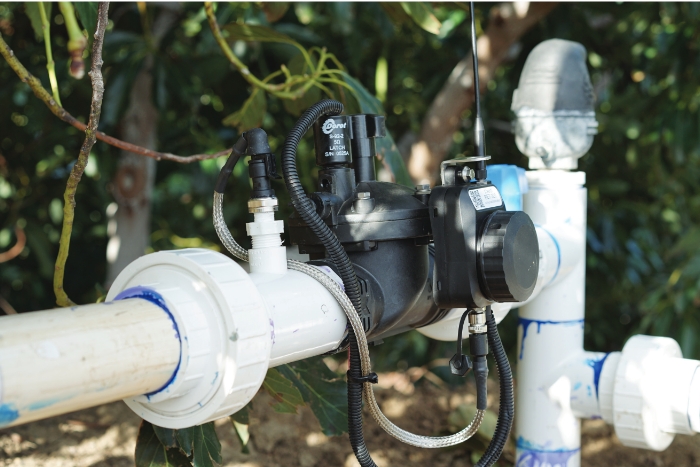
Automated systems enable precise set times tailored to specific crop requirements, Peters explains. This capability is essential for pulse irrigation — the practice of cycling water on and off in short bursts — which uses the same or less water.
“There’s more and more evidence that pulse irrigation helps improve yield and quality,” Peters says. “So, it can do it with the same water or less, and you just can’t do that manually. It has to be done automatically.”
By integrating automation and high-tech monitoring into modern block systems, vineyard and orchard managers are reassessing their approach to irrigation practices, Roddick says. Growers can now tailor moisture delivery to precise geological and topographical requirements to achieve superior distribution uniformity.
“Across a vineyard or orchard, you might be dealing with a half-dozen different soil scenarios,” Roddick says. “Being able to irrigate those blocks differently, you can have a far better outcome.”
In Washington’s orchard environments, for instance, Roddick explains that apple, pear and cherry growers can benefit from this irrigation approach because it addresses variety-specific vulnerabilities. For example, Honeycrisp apples require specialized irrigation strategies to prevent physiological issues and fruit damage. Beyond simple hydration, these systems regulate canopy temperature, which is essential to prevent sunburn and bruising during extreme heat events.
Furthermore, the applicability of this technology extends across a wide spectrum of specialty crops, including blueberries, strawberries and avocados. Roddick argues that while irrigation strategies and water-saving metrics may differ significantly between a berry field and an avocado grove, the underlying challenges of manual water management remain universal. By dividing plantings into distinct blocks based on variety or environmental sensitivity, growers can move away from generalized irrigation and toward a high-resolution approach that treats each section of the farm as a unique production unit.
“Moving to a more automated system where you’re monitoring this all at a block level, it’s going to have material effects on your quality and yield. And no farmer needs convincing that that’s true.”
— Steele Roddick, senior digital marketing manager, Lumo
When considering ag irrigation tech like the modern block system, a psychological “trust-and-acceptance” barrier remains one of the biggest hurdles. According to irrigation insiders, this friction point occurs when growers accustomed to doing things manually struggle to place their faith and futures into high-tech systems. If they don’t fully trust and accept the system, they will never realize the technology’s full return on investment. In the end, the investment essentially goes to waste.
According to Kozak, building trust in autonomous irrigation technology requires a transparent approach to risk management and system visibility. His acceptance strategy is anchored in hardware redundancies, such as maintaining a secondary control system in parallel with the main pump to ensure that the equipment is never at risk of damage. Furthermore, he says, fail-safe architecture ensures that even as the system takes on more responsibility, the integrity of the farm’s infrastructure remains protected.
Additionally, Kozak advocates a phased implementation strategy to help growers increase their comfort levels at a manageable pace. By starting with simple, low-risk automated tasks, operators can build confidence before moving toward more complex configurations. The system supports this evolution through various operational modes, ranging from a basic manual-assist for those who prefer greater oversight to fully autonomous for experienced users. This approach allows each operation to customize its transition to automation, ensuring that the technology aligns with the individual grower’s specific risk tolerance and management style.
“Trust is really important because [these systems impact] the farmer’s livelihood,” Kozak says. “You need to trust that a system will not damage your crops, which they’re relying on for the revenue of their business.”