Every water application carries real costs — energy, labor, equipment wear, water usage and potential yield loss. Without regular measurement and equipment maintenance checks, those costs can quickly add up.
“Better alignment between irrigation and crop demand leads to more stable soil moisture, reduced crop stress and more consistent crop development,” says Wes Dyer, agronomist at Riverside, California-based IRROMETER. “When growers have feedback from real-time data, it gives them the confidence and full picture needed to guide their irrigation decisions. Over time, these improvements support more consistent crop performance and yield outcomes.”
Today, growers have more insights into their water usage patterns than ever before. Increasingly, center pivots include flow meters, pressure sensors and telemetry systems that allow growers to monitor water applications in real time and compare them with crop needs. Together, these tools help growers understand how much water was applied, how well the system performed and whether irrigation matched crop demand.
“Sometimes we start talking technology, flow meters and all kinds of sensors, but at the end of the day, it comes back to understanding how much water you’re putting on and how uniformly you’re putting it on across the field,” says Jake Beam, CID, CAIS, technical sales manager for Reinke Manufacturing, based in Deshler, Nebraska.
Data-informed irrigation decisions are critical as growers contend with tighter margins, rising energy costs and increased water-use reporting. When growers use the collective data available in their center pivot, they can reduce unnecessary irrigation incidents, lower pumping and energy costs, and ensure better timing of water applications.
“If you can make eight passes instead of 12 to 13, that’s money in your pocket,” says Josh Mosier, CAWM, CID, technical director at Komet Irrigation Corp. in Fremont, Nebraska. “It’s also important to remember that overwatering isn’t just about water waste. If you water too much, critical nutrients —nitrogen specifically — can leach out of the root zone and impact yield.”
“A system that is easy to interpret will be used far more effectively than one that tries to do everything at once.”
— Wes Dyer, agronomist, IRROMETER
The sensors on modern center pivots generate a large volume of data. But before that information can guide irrigation decisions, the equipment must be operating as intended. Growers must be able to recognize when it’s not. Identifying real issues can’t be done from a distance. It requires regular inspection and measurement, which is one reason Beam encourages all growers to test and document pressure monthly. Doing so builds a water efficiency story over time.
“If pressure changes at the center point, it can tell you that you probably have some type of failure,” he says. “A pressure change might not tell you exactly where the issue is, but it’s likely in the sprinkler devices, in a gun, or it’s a pumping problem.”
Beam also encourages growers to contact their dealer and request a flow test. Flow tests help identify clogged nozzles, leaks, pump problems or broken parts. Equipment isn’t designed to last forever — maintenance is needed to ensure optimal water application. Yet many center pivots are 30, 40 or 50 years old and have never been inspected.
“Sprinkler retrofit packages are low cost and give the highest reward on the back end,” he says.
Each sensor on a center pivot plays a distinct role in understanding system performance. Flow meters quantify how much water is applied. Pressure sensors confirm the system is operating within design parameters. Telemetry makes that information accessible remotely, often in near real time, explains Dyer.
Collectively, these tools eliminate the guesswork in planning irrigation schedules alongside weather forecasts and field observations. Without reliable information, growers can only assume that the scheduled program ran and applied water as intended.
“This matters because irrigation decisions are often time sensitive,” Dyer says. “When growers can confirm application and system operation in real time, they remove guesswork and are better positioned to make timely adjustments.”
With so much data available, the challenge isn’t access; it’s understanding and using that data. Maximizing the value of irrigation data starts with simplicity.
“Begin with a small number of well-placed soil-moisture sensors, focus on trends rather than individual readings and review the data regularly,” Dyer says. “A system that is easy to interpret will be used far more effectively than one that tries to do everything at once.”
In many regions, water-use reporting requirements are becoming more comprehensive. Integrating data points from center pivot sensors with soil-moisture readings and weather forecasts helps growers comply with regulatory reporting requirements.
“Flow meters and telemetry systems create a reliable record of water use,” Dyer says. “Growers can export documented data that shows when irrigation occurred, how much water was applied and over what period of time.”
This simplifies compliance and improves transparency as water regulations continue to evolve. In Nebraska, for example, growers must record and report their water usage to the Natural Resources Conservation Service (NRCS). Usage can be collected and reported manually, but sensors, especially flow meters, streamline the process.
“As farms get bigger, it’s harder to collect that data manually, so telemetry plays a big role,” Mosier says. “When telemetry is tied to your flow meters, it will log all that information and make it easier to access the required data and get it over to whatever regulatory department you’re working with.”
Beam added that performance metrics can also help growers take advantage of cost-sharing programs, such as the NRCS’ Environmental Quality Incentives Program (EQIP). Cost-sharing programs often match up to 75% or more to encourage the implementation of water conservation practices.
“Some of the numbers that come from these sensors are needed to meet the minimum requirements for programs like EQIP funding,” he says. “Every jurisdiction has its own set of guidelines, so it’s important to work with your local office.”
“In many cases, the nonuniformity of the sprinkler package is leaving thousands of dollars on the table.”
— Josh Mosier, CAWM, CID, technical director, Komet Irrigation Corp.
Technology advancements are happening at a rapid pace, and while they offer the potential for significant efficiencies, the fundamentals of irrigation performance are critical to using the data available. The basics start with understanding the difference between uniformity and efficiency.
Uniformity refers to how evenly the center pivot applies water across a field. Efficiency describes how much of that water is used by the crop rather than lost to evaporation, deep percolation or runoff.
“Everybody is talking about scheduling,” Mosier says. “That’s the big thing, being able to really look at soil-moisture monitoring for scheduling, and the application efficiency and the uniformity of the application sometimes gets left behind.”
That oversight can directly affect profitability. Through recent field testing, Mosier has seen firsthand what uneven applications cost growers.
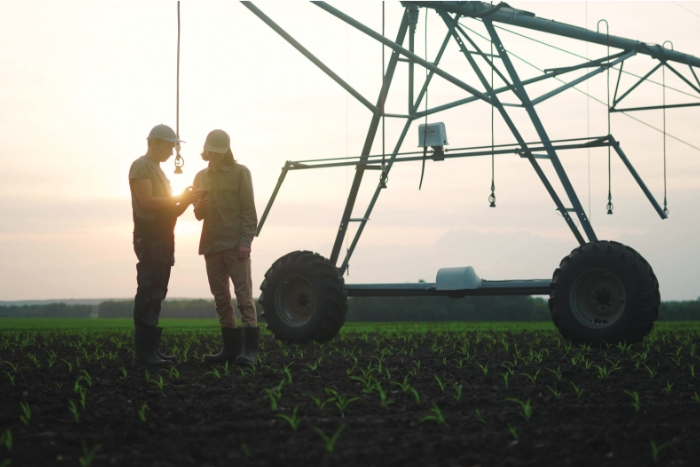 “In many cases, the nonuniformity of the sprinkler package is leaving thousands of dollars on the table,” he says.
Even in Nebraska, the heart of the irrigation world, Beam says many people are still unclear about what uniformity and efficiency actually mean. “It’s important to understand these terms and monitor water usage, because even a 1% change can make a huge difference,” he says.
In 2024, Nebraska experts calculated that ag producers apply about 7 inches across the state, or about 1.7 trillion gallons annually. A 1% reduction in applications or a 1% increase in management could save the state nearly 1.7 billion gallons of water per year.
“That’s just in the state of Nebraska,” says Beam. “That’s why it is important to monitor — 1% can make a huge difference.”
One reason for nonuniformity: Pivots rarely receive the same level of routine attention as other equipment.
“It’s the one big piece of equipment on the farm that never goes to the shop to get gone through every year,” Mosier says. “A lot of times the sprinkler package is an afterthought when it comes to maintenance, and it’s the key to having good water application.”
Center pivot irrigation data has reached a point where growers can see not only how much water they are applying but how well it is being used. Flow meters, pressure sensors, soil-moisture probes and telemetry systems each provide part of the picture.
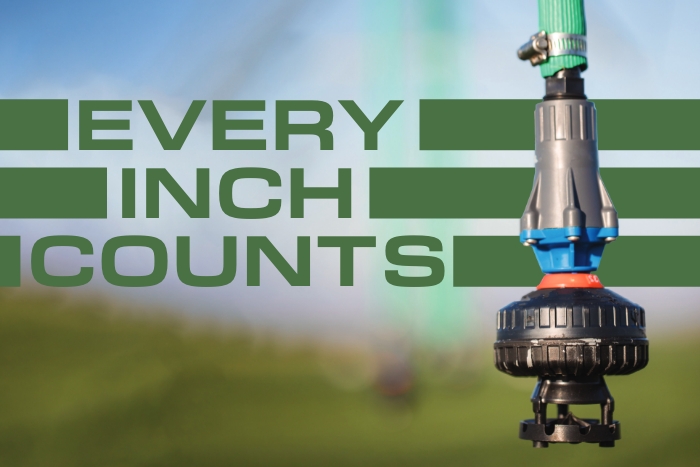
When combined thoughtfully and supported by proper maintenance, they allow growers to make confident, data-driven decisions that maximize every inch of water applied.