
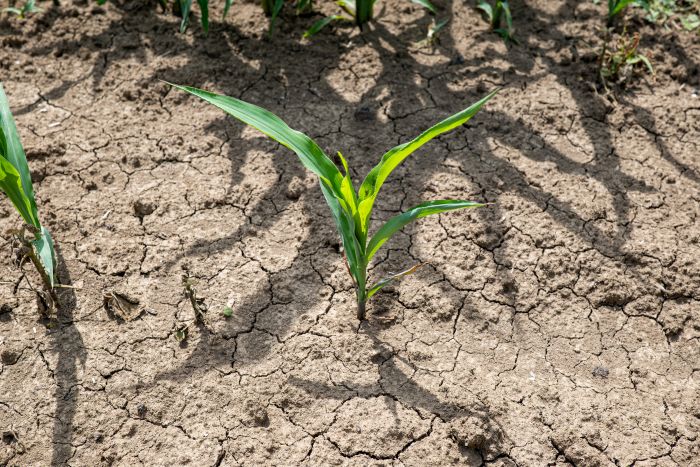
Planning irrigation scheduling, especially during drought conditions, is an ongoing challenge for producers and agricultural irrigation professionals. It’s a challenge researchers across the country are working to solve with the help of emerging technologies, including artificial intelligence. Researchers at the Virginia Tech A3 Lab are focusing on using AI to identify drought stress much earlier than traditional field scouting.
“AI is able to recognize subtle patterns across large volumes of data that are often invisible to the human eye,” said Feras Batarseh, director of the A3 and ACWA Labs, associate professor of biological systems engineering and the faculty lead for the Center for Advanced Innovation in Agriculture. “By identifying these early warning signals days or even weeks in advance, growers can intervene sooner, reducing crop losses while optimizing water use.”
Using modern AI models, including deep learning and computer vision, the A3 Lab is analyzing a range of crop data including leaf temperature, soil moisture dynamics and weather conditions. Using AI to examine the crop measurement data can help detect the physiological effects of water stress before crops begin to wilt or show visible symptoms, Batarseh explained.
“AI also enables continuous monitoring across entire farms, providing a scalable alternative to manual inspections and allowing producers to respond proactively rather than reactively,” he said.
How AI is being used to detect early drought stress
AI systems need high-quality datasets that capture both crop conditions and environmental variables to detect early drought stress. Batarseh explained that datasets come from a variety of sources, including:
Increasingly, researchers also incorporate numerical weather prediction outputs, climate forecasts, topographic information and soil characteristics into AI models.
“The strength of AI lies in its ability to fuse these heterogeneous data sources into a unified prediction model that learns complex interactions between weather, soil, crop physiology and irrigation practices, resulting in more accurate drought stress predictions than any individual data source alone,” he said.
The potential impact for minimizing drought stress
For producers, earlier detection could create a larger window to respond to water stress before it begins affecting crop health and yield. It could also help growers make more targeted decisions about when, where and how much to irrigate, particularly when water supplies are limited.
“Early drought stress detection has the potential to fundamentally change how irrigation decisions are made,” Batarseh said. “Rather than irrigating according to fixed schedules or responding after crops exhibit visible stress, AI can recommend when irrigation is truly needed, where within a field it should be applied and how much water should be delivered.”
These capabilities allow growers to apply water according to real-time crop needs rather than relying on predetermined irrigation schedules. AI can combine near-term weather forecasts, estimated evapotranspiration and crop development data to anticipate how much water plants will require.
The technology can also factor expected rainfall into irrigation decisions, helping growers avoid watering when precipitation may provide sufficient moisture. More precise timing and application can support healthier crops, reduce wasted water and help farms make better use of available supplies during drought and other periods of water scarcity.
“The goal is not to replace the expertise of growers but to augment their decision-making with data-driven insights that improve resilience, productivity and sustainability,” he said. “As droughts become more frequent and water resources become increasingly constrained, AI will play an essential role in enabling predictive rather than reactive water management.”
Over time, these tools could play an important role in building more resilient agricultural systems and protecting both food production and water resources.
“We envision a future where irrigation decisions are continuously informed by real-time intelligence, allowing every drop of water to be used more efficiently while maintaining agricultural productivity and strengthening long-term food and water security,” he said.
Learn more
Agricultural irrigators interested in adopting AI-based drought monitoring have several pathways available. Batarseh said the lab invites those interested to reach out with questions and to explore collaborations. To learn more about the work being done at Virginia Tech and the A3 Lab, visit these websites.
Share on social media:

3030 Clarendon Blvd. | Suite 300 | Arlington, VA 22201
Tel: 703.536.7080 | Fax: 703.536.7019
HOME | ABOUT US | ADVERTISE | SUBSCRIBE | CONTACT | PRIVACY POLICY | IA ANTITRUST STATEMENT