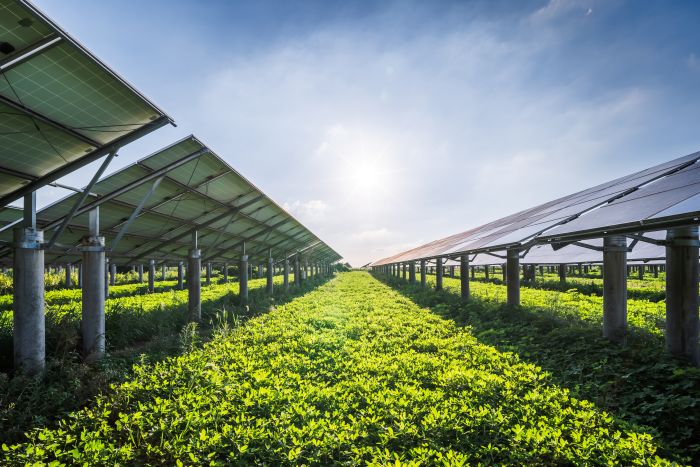
University of California Davis researchers are investigating whether installing solar panels in farm fields could help growers conserve water while producing electricity. The three-year study is funded by the California Department of Food and Agriculture.
Researchers are studying the viability of agrivoltaics—using solar panels to generate energy and shade plants from too much sun. Winter and summer tomato crops are being tested under different solar designs and differing irrigation schedules. Subsurface irrigation lines feed two adjacent tomato fields. One receives 100% of the water the crop typically needs, the other gets just half. Researchers will measure water efficiency and how the microclimate created beneath the solar cells changes evapotranspiration (ET) rates.
The agrivoltaics industry is relatively small today, but researchers are using the UC Davis agrivoltaics site as a testing ground for potential future applications. Upfront investments are a major barrier, with installation costs for a 100-kilowatt system averaging $250,000–$300,000.