Cover crops are a cornerstone of conservation agriculture; however, their effectiveness in reducing irrigation demands often is dependent on where crops are grown. Conservation systems that work well in the Midwest might not translate to the Midsouth. Warmer temperatures and high humidity cause crop residue to break down faster, making it more difficult for growers to build and maintain biomass and soil organic matter. Pests and planting can also interfere. Crop type plays a role, too — what works in cotton might not be a fit in corn.
To better understand how to strike the balance between water savings and optimal yields in irrigated row-crop production systems employing conservation practices, scientists in the Mississippi Agricultural and Forestry Experiment Station, or MAFES, at Mississippi State University knew they had to be on target and account for every drop of water going onto and coming off the field.
Their work spans two decades and two distinct parts of Mississippi, traversing the silt loam soils of the Mississippi Delta near Stoneville to the silty clay of the Black Belt Prairie near Brooksville.
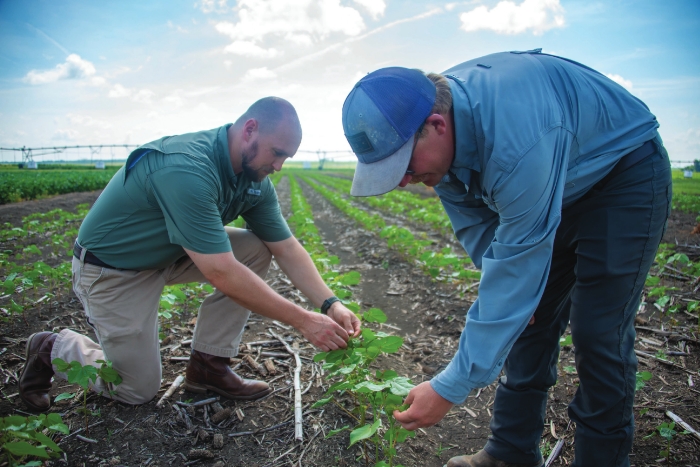
Drew Gholson, MAFES plant and soil sciences associate professor, led the Stoneville study, in which he evaluated how conservation practices affect soil moisture, irrigation demand and water-use efficiency in cotton production.
“With this system, we can measure every drop of water that enters and exits each plot, which allows us to create targeted water budgets for individual plots,” said Gholson, who is also coordinator of the National Center for Alluvial Aquifer Research, a Mississippi State-U.S. Department of Agriculture collaborative unit.
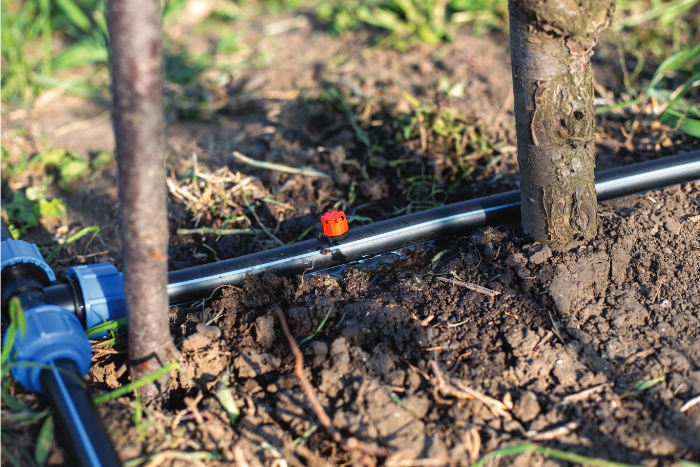
In Stoneville, each of the 21 research plots had its own irrigation riser and meter. Long drainage pipes extending from the plots carried water away, while monitoring stations measured water leaving each plot.
That precision allowed researchers to quantify the irrigation benefits of cover crops and reduced-tillage practices. The five-year study’s findings, recently published in Agricultural Water Management, showed that cover crops improved soil moisture, increased rainfall infiltration and reduced irrigation requirements. In addition, in some years, some cover-crop treatments did not require supplemental irrigation.
Researchers used soil-moisture sensors in each plot to determine when irrigation was necessary. The team found a significant relationship between the amount of cover-crop biomass produced during the off-season and the moisture retained in the soil profile. More biomass was associated with more stored soil moisture, which could delay the first irrigation.
The study also provided insight into raised beds. In the flat Mississippi Delta landscape, producers often hesitate to eliminate tillage because raised beds are important for irrigation and drainage, especially when heavy spring rainfall threatens early-planted crops.
“A farmer a lot of times will say, ‘I’ve got to make beds,’” Gholson said.
After five years, however, beds in the no-till, cover-crop treatment group remained higher than conventionally managed beds that had recently been re-bedded. Gholson said the cover crops and soil structure helped hold the beds together.
Now, researchers are taking lessons from the Delta and asking new questions at the MAFES Black Belt Branch in Brooksville.
Dave Spencer, plant and soil sciences associate professor and scientist in the university’s Water Resources Research Institute, is studying how tillage, row spacing, fertility management and irrigation practices affect crop productivity and water use across multiple crop rotations.
The change in location is significant. Instead of the Delta’s silt loam, researchers at Brooksville are working with heavier silty clay underlain by limestone. Differences in soil and production environments influence water movement, drainage and tillage decisions, giving researchers an opportunity to determine how conservation strategies perform under very different conditions.
“What excites me most is identifying new management strategies that deliver meaningful benefits to growers in Mississippi and throughout the Midsouth,” Spencer said. “I think we have a real opportunity to do that through improvements in tillage, row spacing and fertility management.”
Like the Delta work, the Brooksville research is built around individually monitored field plots with 27 long drainage pipes. Soil-moisture sensors and irrigation equipment across the plots allow scientists to track water movement and measure water-use efficiency.
Researchers are comparing conventional and conservation-based production systems in corn-soybean and corn-cotton rotations. Treatments include wide and narrow row spacings, alternative nitrogen-management strategies, and no-till, reduced-tillage and cover-crop systems.
The research is designed around the realities producers face rather than maximizing the benefit of any single conservation practice.
Spencer points out cover crops as an example. “Cotton’s later planting date can give a winter cover crop more time to accumulate biomass in March and April. That additional biomass was associated with greater soil moisture in the Delta cotton research,” he said. “Corn requires a different strategy, with cover crops typically terminated several weeks prior to planting. There are so many benefits associated with planting corn in March or April that we don’t want to sacrifice the cash crop to let the cover crop grow.”
That trade-off speaks to the work’s larger objective: identifying management practices that will conserve water while maintaining productivity and profitability. Backed by years of field research, MAFES scientists are helping producers determine which practices work best under specific agronomic and environmental conditions, with the goal of saving water without sacrificing yield.
The Brooksville project is funded by MAFES, the USDA’s Agricultural Research Service Long-Term Agroecosystem Research Network, the Mississippi Corn Promotion Board, the Mississippi Soybean Promotion Board and Mississippi State’s WRRI. Research company Cotton Incorporated funded the Stoneville study.
Learn more about MSU’s Department of Plant and Soil Sciences at pss.msstate.edu. Learn more about the Water Resources Research Institute at wrri.msstate.edu.
3030 Clarendon Blvd. | Suite 300 | Arlington, VA 22201
Tel: 703.536.7080 | Fax: 703.536.7019
HOME | ABOUT US | ADVERTISE | SUBSCRIBE | CONTACT | PRIVACY POLICY | IA ANTITRUST STATEMENT