
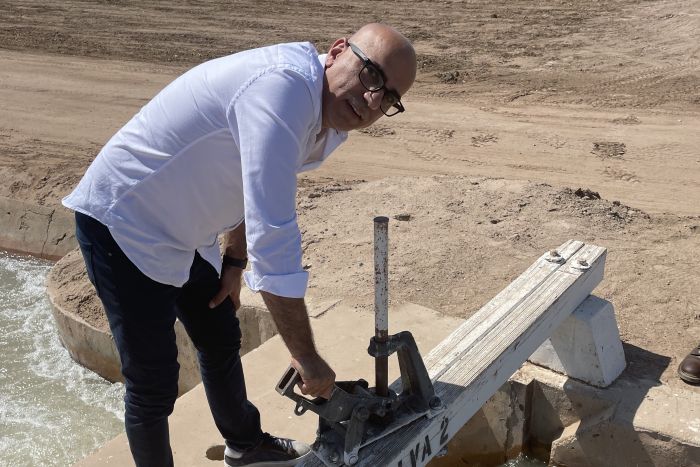
After nearly 30 years of developing irrigation technology at Netafim, Abed Masarwa believes innovation requires a willingness to keep learning, challenge assumptions and reinvent yourself. For him, innovation is about waking up “hungry” every day and continually reinventing yourself.
A mechanical engineer with an MBA, Masarwa has held roles spanning engineering, research and development and technical leadership in the Asia-Pacific region. Today, he leads Netafim Orbia’s product team, drawing on decades of experience translating farmers’ challenges into practical irrigation solutions.
“Irrigation gave me something I found quite satisfying right from the start,” he said. “The chance to take engineering out of the laboratory and bring it to life out in the field.”
Listening to farmers around the world has helped him identify opportunities to improve irrigation technology while realizing that not all farmers don’t face exactly the same challenges.
“Working with farmers in many parts of the world has given me enormous respect for the diverse ways people practice agriculture,” he said. “Every crop, climate and farm presents a different set of challenges, so there is always something new to learn.”
Masarwa was named the Irrigation Association’s 2026 Innovator of the Year. Here he shares what drew him to irrigation and his approach to advancing irrigation technology.
IA: What first sparked your interest in irrigation technology?
Masarwa: I’ve always liked building things and understanding why they work, or why they don’t. Early in my career, I could take an idea to the manufacturing floor, build a prototype, test it and sometimes quickly discover that my first idea wasn’t the right one. I enjoyed that process because it led to a genuine solution. It was a hands-on, rapid prototyping approach, like the method Tom Chi advocates.
Working with irrigation made it even more rewarding because the result wasn’t just a better component. The right designs could significantly improve how water moved through a field and make a system easier for a farmer to use. That made engineering feel real and meaningful to people’s lives.
IA: What irrigation technology innovation most excites you?
Masarwa: I’m still impressed by how much we are continuing to improve drip irrigation. The principle hasn’t changed. The goal is to deliver water and nutrients where the crop needs them and can best use them.
But our ability to do that with precision across slopes, long rows, different soils and such a wide range of crops has advanced tremendously. Farmers face multiple challenges today, including a significant labor shortage and increasing climate-related pressures, which drives us to develop solutions that address them.
Pressure compensation in drip is one example that I find particularly vital to effective irrigation. It delivers much more uniform water, even under difficult field conditions. What interests me now is how we can bring that kind of high-level performance to more applications and make precision irrigation accessible to farmers who haven’t had the opportunity to use it.
IA: Your superpower is turning field insights into practical and scalable solutions for growers. Can you share how farmer feedback drives innovation?
Masarwa: Some of the most useful product conversations I’ve had started with a farmer saying, “This is giving me some trouble.”
While I was working in Asia, we kept hearing that thin-wall driplines were damaged during installation and retrieval. When you hear the same complaint from growers in different places, you realize it’s not an isolated problem. That feedback led us to develop a more durable thin-wall dripline.
IA: What emerging irrigation technologies are you most excited about?
Masarwa: As irrigation systems become more connected to sensors and automation, they’re generating a lot of data that can help solve common challenges like projecting input needs, diagnosing crop health, managing labor needs and autonomously adjusting schedules. AI can be a powerful tool when it’s applied to specific tasks, such as adjusting fertigation or helping growers respond faster to changing, real-time field conditions.
Connected systems also give growers a clearer picture of what’s happening in their fields. Like a car dashboard, they provide information about system performance that growers can use to monitor conditions and adjust their irrigation accordingly.
The challenge isn’t adding more technology for its own sake. The opportunity is to make irrigation easier to understand and control, especially when water, labor, fertilizer and energy are all expensive or limited. The best technology should reduce uncertainty in growers’ routines instead of adding another thing they have to manage.
IA: What advice would you offer young irrigation professionals who may be interested in following a similar career path?
Masarwa: Follow your passion and spend time outside your own specialty. Talk to farmers, walk fields with technicians, visit manufacturing and listen to agronomists. You’ll better understand and appreciate your own work when you see how it connects with everyone else’s.
I would also tell young engineers not to be afraid of being wrong occasionally. Some of the most useful moments in product development come when a prototype doesn’t perform the way you expected. It’s an opportunity to learn, make a change and try again and again if needed. After nearly 30 years, that part of the work still absorbs me. There is always another problem worth solving.
Share on social media:

3030 Clarendon Blvd. | Suite 300 | Arlington, VA 22201
Tel: 703.536.7080 | Fax: 703.536.7019
HOME | ABOUT US | ADVERTISE | SUBSCRIBE | CONTACT | PRIVACY POLICY | IA ANTITRUST STATEMENT