As water resources tighten and pumping costs rise, irrigation efficiency is becoming an increasingly important driver of profitable crop production. In Nebraska, where irrigation depends heavily on the Ogallala Aquifer, producers face growing pressure to apply water more precisely than ever before.
Traditional irrigation scheduling tools such as soil-moisture sensors and evapotranspiration scheduling are highly effective but often operate independently, leaving producers to manually integrate multiple data streams without providing clear decisions. This is where emerging generative AI tools may offer new opportunities.
Generative AI models such as ChatGPT are designed to synthesize information quickly and communicate recommendations in a practical, conversational format. Unlike traditional decision-support tools that rely on fixed rules or dashboards, generative AI can integrate multiple inputs (such as sensor readings, weather forecasts, soil properties and crop stage) to provide a clear recommendation along with the reasoning behind it.
For irrigators, the potential value lies not in replacing agronomic expertise, but in helping interpret complex information more quickly and supporting more timely management decisions.
We evaluated the potential of generative AI for irrigation decision-making through the University of Nebraska-Lincoln’s Testing Ag Performance Solutions (TAPS) program. TAPS is a season-long farm management competition in which participants submit real-world decisions on irrigation, fertilizer and other inputs. Those decisions are implemented on university research fields, allowing teams to compare management outcomes under the same field conditions.
In the 2024 season, we used the ChatGPT-4o model to generate all management decisions, despite having no farming experience. The model was provided with key information such as crop type and growth stage, past and forecasted weather conditions, irrigation costs and previously applied irrigation. Soil-moisture sensor data were also included, either as direct soil water content values or screenshots showing moisture trends. We then asked the model specific questions. For example: “Considering all the data provided and a maximum irrigation depth of 1 inch, how much irrigation should be applied tomorrow?” The recommended irrigation depth was then implemented within the competition.
In 2025, the approach evolved further. Four custom GPTs were developed to compete in four separate TAPS contests in North Platte and Mead, Nebraska. Each model was configured with competition-specific information.
The AI-managed plots achieved the following grain yields in bushels per acre, along with their yield and profitability rankings among participating teams:
| TAPS contests | Yield (bu/ac) | Number of teams | Yield rank | Profit rank |
|---|---|---|---|---|
| North Platte sprinkler corn | 255 | 28 | 7 | 13 |
| Mead sprinkler corn | 167 | 30 | 1 | 17 |
| Mead nitrogen source corn | 191 | 18 | 6 | 15 |
| Mead sprinkler soybean | 70 | 30 | 17 | 16 |
Overall, the results suggest that AI-assisted management can perform competitively with top human-managed systems under structured conditions. However, additional testing across more years, sites and management scenarios is needed before drawing broader conclusions.
We identified two practical ways generative AI tools could support irrigation management.
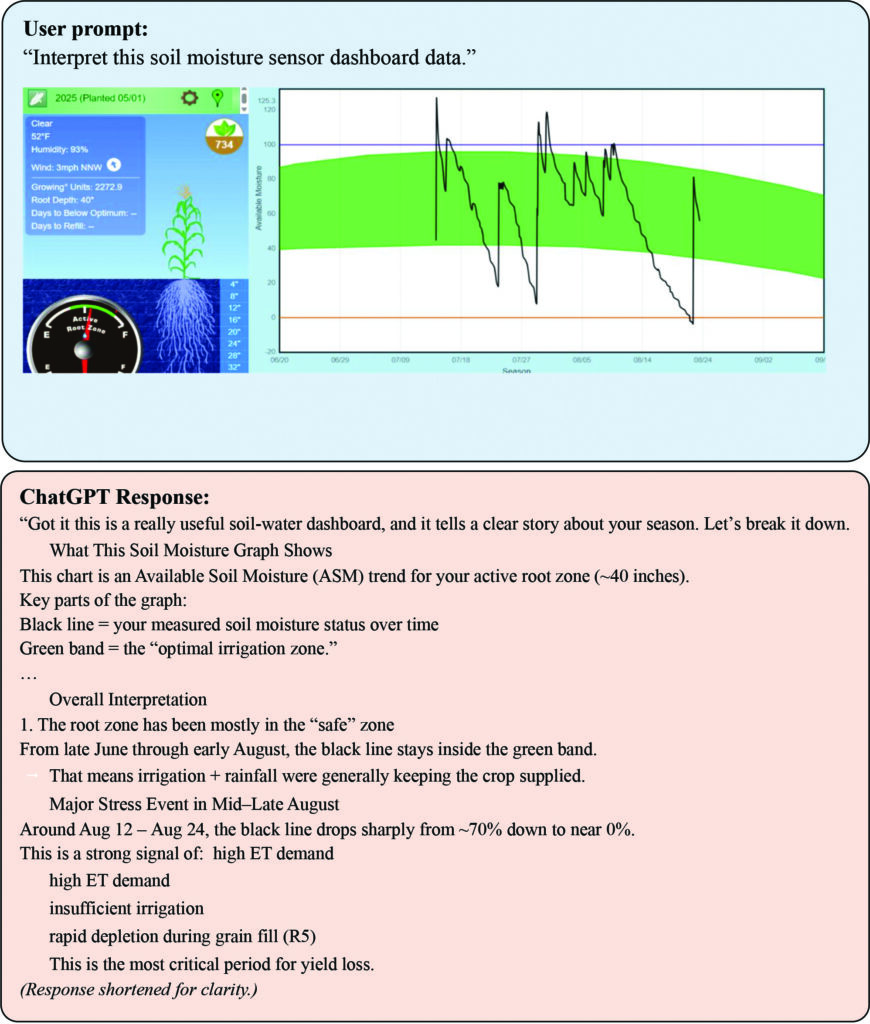
One immediate benefit of generative AI is its ability to summarize and interpret irrigation-related data quickly. Producers can use AI to interpret weather forecasts, estimate crop water demand, analyze soil moisture trends and translate technical data into actionable insights. Instead of viewing sensor graphs in isolation, producers can ask AI systems to explain what the trends suggest about soil water depletion, stress risk or refill needs.
However, the quality of the response depends on the information provided. Users must clearly describe the situation and include relevant data. Prompts can be entered by typing or voice, and supporting files such as PDFs, images or documents can be attached.
User prompt: “Interpret this soil moisture sensor dashboard data.”
ChatGPT response (shortened for clarity): “Got it, this is a really useful soil-water dashboard, and it tells a clear story about your season. Let’s break it down. The root zone has been mostly in the ‘safe’ zone. From late June through early August, the black line stays inside the green band. That means irrigation and rainfall were generally keeping the crop supplied. Around Aug. 12 to Aug. 24, the black line drops sharply from about 70% down to near 0%. This is a strong signal of high ET demand, insufficient irrigation and rapid depletion during grain fill (R5). This is the most critical period for yield loss.”
Generative AI can also assist with irrigation decisions when provided with accurate and sufficient information. For example, a grower might input soil texture, soil profile, current soil water content, growth stage, rooting depth and irrigation system limits (e.g., maximum application per event). Using this information, the AI can estimate soil water depletion and recommend an irrigation depth consistent with field and irrigation system constraints.
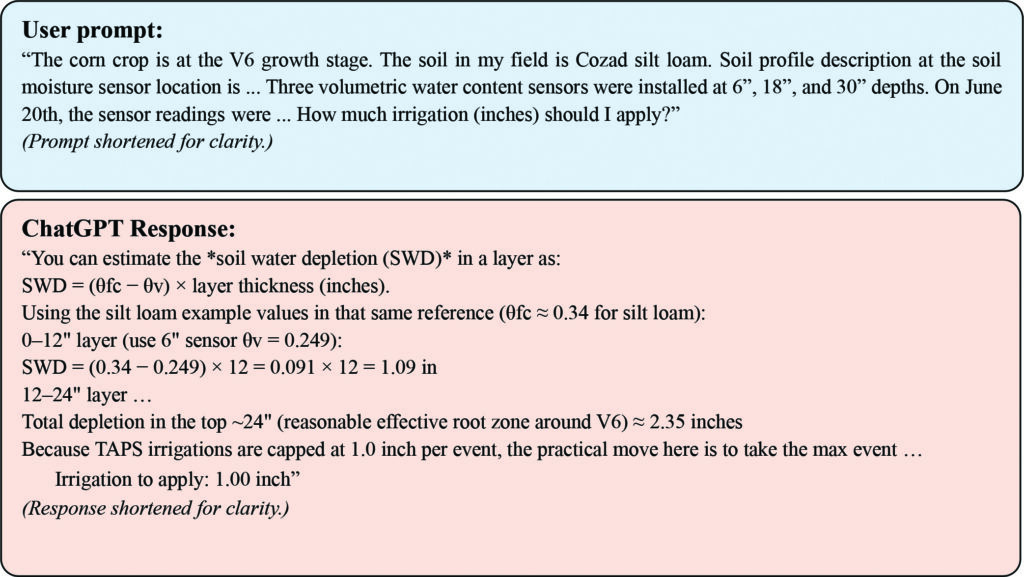
User prompt: “The corn crop is at the V6 growth stage. The soil in my field is Cozad silt loam. Soil profile description at the soil moisture sensor location is … Three volumetric water content sensors were installed at 6″, 18″ and 30″ depths. On June 20th, the sensor readings were … How much irrigation (inches) should I apply?”
ChatGPT response (shortened for clarity): “You can estimate the soil water depletion (SWD) in a layer as: SWD = (θfc − θv) × layer thickness (inches). Using the silt loam example values in that same reference (θfc ≈ 0.34 for silt loam): 0–12″ layer (use 6″ sensor θv = 0.249): SWD = (0.34 − 0.249) × 12 = 0.091 × 12 = 1.09 in. Total depletion in the top ~24″ (reasonable effective root zone around V6) ≈ 2.35 inches. Because TAPS irrigations are capped at 1.0 inch per event, the practical move here is to take the max event … Irrigation to apply: 1.00 inch.”
AI tools can also assist with more complex decisions. For example, when users include current grain prices and irrigation costs, the system can evaluate whether the expected yield benefit of an irrigation event is likely to cover the pumping cost.
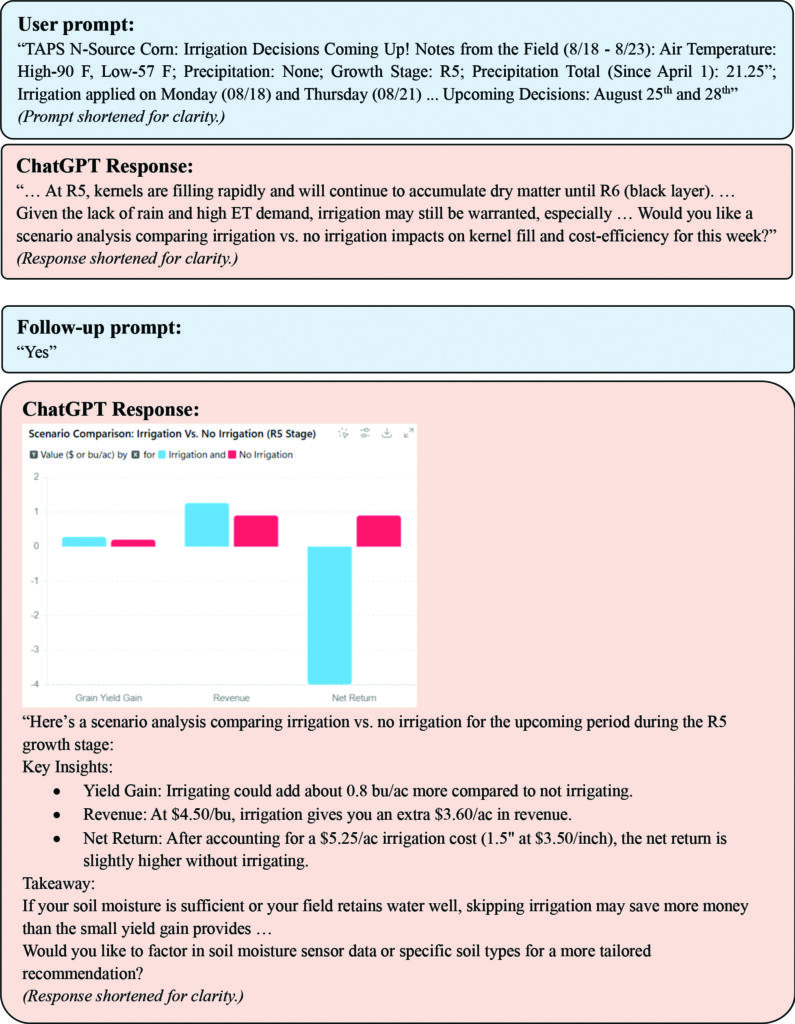
User prompt: “TAPS N-Source Corn: Irrigation Decisions Coming Up! Notes from the Field (8/18 – 8/23): Air Temperature: High-90 F, Low-57 F; Precipitation: None; Growth Stage: R5; Precipitation Total (Since April 1): 21.25″; Irrigation applied on Monday (08/18) and Thursday (08/21) … Upcoming Decisions: August 25th and 28th”
ChatGPT response (shortened for clarity): “… At R5, kernels are filling rapidly and will continue to accumulate dry matter until R6 (black layer). … Given the lack of rain and high ET demand, irrigation may still be warranted, especially … Would you like a scenario analysis comparing irrigation vs. no irrigation impacts on kernel fill and cost-efficiency for this week?”
Follow-up prompt: “Yes”
ChatGPT response (shortened for clarity): “Here’s a scenario analysis comparing irrigation vs. no irrigation for the upcoming period during the R5 growth stage: Yield Gain: Irrigating could add about 0.8 bu/ac more compared to not irrigating. Revenue: At $4.50/bu, irrigation gives you an extra $3.60/ac in revenue. Net Return: After accounting for a $5.25/ac irrigation cost (1.5″ at $3.50/inch), the net return is slightly higher without irrigating. Takeaway: If your soil moisture is sufficient or your field retains water well, skipping irrigation may save more money than the small yield gain provides …”
While generative AI tools show strong potential, they must be used carefully. Key considerations include:
Used appropriately, generative AI can function as an assistant, not a replacement for irrigation decision-making.
The future impact of generative AI in irrigation will depend on stronger integration with high-quality data and existing irrigation technologies. Future opportunities may include:
With continued development, these tools may help improve both profitability and long-term water sustainability.