For growers, agriculture is a high-stakes game, and relying on a lone soil probe as the foundation for irrigation decisions is becoming a thing of the past.
To combat operational blind spots, the concept of “sensor stacking” — also known as data fusion or multilayer data integration — is gaining traction. This water-management strategy layers agronomic, atmospheric and spatial data streams into a single dashboard, pivoting water managers from reactive scheduling to proactive predictive modeling. Sensor stacking provides the agility required to eliminate guesswork, maximize crop yields, protect soil health, and rein in water and labor costs.
An isolated data source offers limited utility, but a stacked sensor ecosystem functions as a high-octane analytical engine offering comprehensive operational insight. Sensor stacking democratizes sophisticated resource allocation, optimizes asset management, and provides growers and irrigation managers the flexibility required to make more profitable decisions.
This stacking philosophy, according to irrigation experts, relies on three core data pillars:
Stacking metrics like volumetric soil data with real-time ET rates gives growers and irrigation managers the ultimate precision toolkit, says Matt Yost, an agroclimate extension specialist in Utah State University’s Department of Plants, Soils and Climate.
“It gives you an even clearer picture of the water needs of a given crop,” Yost says. “It’ll help you refine your irrigation management. Basically, replace evapotranspiration without exceeding it. We’re trying to bring it up to that line of what a crop needs, because anything over that line may waste water.”
Despite its benefits, this practice has not been widely adopted, especially among traditional growers who rely on visual inspection and gut feelings to make their irrigation decisions.
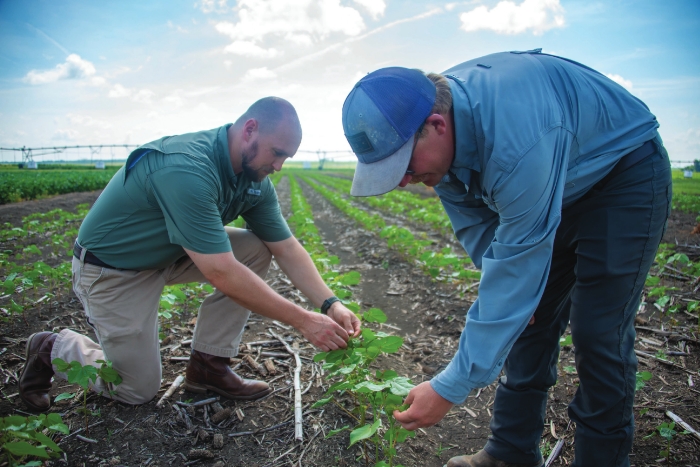
While manual methods including soil probing and firsthand observations remain common in agriculture, Abia Katimbo, an assistant professor and irrigation management specialist at the University of Nebraska-Lincoln, points out that these practices offer uncertain information and an aggregated guess at what’s really happening in the soil profile and inside the plant.
“You can see the crop and how it’s performing, but you can’t measure the exact moisture that’s in that soil,” Katimbo says. “So, we tell [growers] that even using a soil probe, that one technology isn’t enough data to tell you what’s really going on.”
Growers and irrigation managers always aim for the soil’s “Goldilocks” zone, the sweet spot between field capacity and the critical dryness threshold where roots can easily draw moisture for growth and to avoid stress. By measuring the actual soil moisture using available commercial soil moisture sensors or probes specifically across the active root depth, Katimbo explains, growers can determine exactly how many inches of irrigation to apply.
Watering past what the root zone can hold wastes resources and leaches nutrients below the plant’s reach. However, failure to adjust sensors as roots grow deeper will leave a grower or irrigation manager blind to what’s happening underground, leading to miscalculations of a crop’s actual water needs.
Yost says analytical, margin-conscious growers demand strict per-acre return on investment metrics before adopting new tech, seeking returns related to time reclamation, quality of life and localized proof. But when pioneering neighbors successfully implement stacked data systems, he says, adoption spreads.
“Often, it’s what the neighbor does,” Yost says of ag-tech use among early adopters. “If a neighbor is using a new technology and they really like it and are talking it up, it just kind of catches on.”
Artificial intelligence is popping up just about everywhere, so it’s no surprise the technology is seen as a fit for data collection and managing irrigation decisions. However, the efficacy and safety of granting AI full, autonomous control over a complex irrigation system remains the subject of debate.
Despite the promise of an automated, closed-loop system, Vicente Ossa, marketing strategy manager at WiseConn USA, says complete automation without oversight is still discouraged.
AI-driven software can handle the heavy analytical workload of crunching data streams from sensor stacking, but human thinking remains a crucial component of the broader strategy. In the end, Ossa says, a grower or irrigation manager must validate the decision to turn on the water.
Advanced sensor platforms stack multiple data streams to generate irrigation schedules, but they function as open-loop systems that require a human operator to review and manually execute the recommendations. According to Matt Yost, an agroclimate extension specialist at Utah State University’s Department of Plants, Soils and Climate, AI is being integrated into these platforms to refine predictive estimations. This evolution is driving the industry toward fully autonomous, closed-loop systems capable of managing irrigation infrastructure without manual intervention.
This shift highlights a critical tension between algorithmic efficiency and human intuition.
Drawing a parallel to residential smart controllers, Yost emphasizes that while automation provides significant convenience by reacting to real-time weather shifts and plant needs, human operators still frequently override the system. Immediate visual assessments, such as simply observing plant health in the field, often reveal nuances that standard programmatic sensors miss.
“I don’t know that a fully AI-enabled irrigation system can anticipate all of the issues and other things that a human can detect and adjust,” Yost says. “Like with my irrigation controller at home, I don’t always trust it. I modify it all the time because I can see the grass and I can kind of estimate what’s needed and what’s not needed. And I can shut it off when other issues come up.”
Ultimately, Yost sees AI-driven closed-loop irrigation as a net positive for the agricultural industry, provided that human managers retain an active oversight role to validate autonomous decisions against real-world physical observations.
As these connectivity barriers continue to dissolve, Khot says the promise of refined, “brilliant” AI-driven irrigation management becomes a practical reality for the modern grower.
Growers who integrate multiple sensor technologies to drive irrigation decisions can realize substantial savings across water, fertilizer, labor and energy, says Vicente Ossa, marketing strategy manager at WiseConn USA. The Fresno, California-based ag-tech company develops cloud-based precision irrigation and water-management systems worldwide.
While water conservation is a primary outcome, Ossa says layering data from soil moisture probes, weather stations and plant sensors enables growers to optimize nutrient applications based on plant demand.
In fact, in agricultural regions such as the American Midwest and Colombia in South America, where water scarcity is less urgent, growers often justify their technology investment based solely on fertilizer savings, particularly amid rising input costs.
“They’re able to understand the needs of the plant at precise moments in [the growing cycle],” Ossa says. “They can pinpoint that during this time of the day, or this day of the week, this is the amount of fertilizer needed for optimal health.”
The ROI expands further when sensor data is integrated with automated valve and pump controls, Ossa says. In the Pacific Northwest, for example, a systemic shortage in ag labor is accelerating the adoption of automated irrigation technology. Beyond eliminating the need for physical checks and monitoring, this technology enables data-driven decision-making, delivers more accurate information faster and allows for easier execution based on exact soil tension and crop ET rates.
“Farmers are already wearing multiple hats and juggling a long list of daily tasks,” Ossa says. “Instead of having people dedicated to opening and closing farm valves, technology lets you relocate those workers to where they add more value and leave the valve opening to automation.”
Irrigation takes an enormous amount of electricity to push pumps. Leveraging real-time data provides growers a path to navigate the complexity of their power grids. Stacking sensors doesn’t just save water. It cuts peak-load power demand, which can be a grower’s highest line-item expense. In ag-heavy states like California, accurate irrigation data management and automation technology make it easy to schedule irrigation cycles during low-demand, off-peak energy cycles without sacrificing crop health.
“Irrigating at night rather than during the day saves more than just water,” Ossa adds. “In states like California, growers are actually financially compensated for shifting their water use away from peak electricity hours.”
While sensor stacking gives growers powerful information for precision irrigation, layering these technologies introduces significant economic and practical hurdles. Unsurprisingly, cost tops the list. Capital and operational expenses spike quickly when purchasing, deploying and maintaining multiple hardware networks.
For example, Katimbo highlights the costs associated with tracking crop ET. Advanced, high-tech ET systems are expensive. Even scaled-down commercial versions have spatial limitations and accuracy issues, and often require an annual subscription for data telemetry. This financial barrier forces a grower to manage a 120- to 160-acre center-pivot block with a single sensor location, which he says fails to capture the variable soil and plant health conditions across the entire field.
Sensor stacking — combining data from multiple sensors — allows growers to make precise irrigation decisions. While many operations still rely on a single data stream, such as an isolated soil-moisture probe, to dictate their watering schedules, industry experts suggest that single-source data no longer optimizes water-use efficiency.
Abia Katimbo, an assistant professor and irrigation management specialist at University of Nebraska-Lincoln, suggests growers and irrigation managers wanting to bridge this data gap look into OpenET.
OpenET (etdata.org) is an open-source online platform that provides satellite-based evapotranspiration data at the field scale, primarily across the western U.S. By leveraging data from Landsat satellites alongside public weather networks, the platform calculates crop water use with an 80% to 90% accuracy rate.
According to Katimbo, stacking satellite-driven ET data with ground-based sensors allows growers to capitalize on the unique strengths of both technologies.
“Satellite data captures the broad spatial scale of an entire field but suffers from temporal gaps because satellites do not pass overhead daily,” he says. “And ground-based soil-moisture sensors capture the continuous temporal scale but lack spatial breadth.
“By merging these complementary tools, [growers] can overcome the data fragmentation about what’s happening in their fields and take a more detailed approach to irrigation management,” Katimbo adds.
Additionally, hardware is prone to drift and mechanical failure over time. Stacking additional devices multiplies the risk of telemetry malfunctions, calibration errors, or even physical damage from field equipment and wildlife. Troubleshooting any of these issues is both costly and time-consuming.
Then, there is data overload. This is the information age, and managing numbers from multiple sensor sources can overwhelm growers and irrigation managers, Yost says. Katimbo notes that continuous data logging from a single soil-moisture probe generates a massive volume of daily data points for just one parameter. When growers stack additional layers, such as localized weather station data streams and remote sensing imagery to capture spatial variations across a field, the volume of information becomes unmanageable.
While artificial intelligence (AI) promises to simplify these complex data streams, Katimbo says the technology remains largely in the research phase rather than daily field operations, although some companies are exploring AI solutions. “The industry has yet to confidently prove that AI can seamlessly integrate, summarize and translate these massive, disparate datasets into clear, actionable recommendations,” Katimbo says. “So, [irrigation] decision-making remains highly fragmented.”
Unlocking the practical value of these field insights while avoiding cognitive overload requires a delicate balance. The utility of these data streams depends on the specific hardware used and the grower’s comfort level in interpreting the data, Ossa says.
“We have clients who swear by soil moisture probes because the data is reliable and easy for them to interpret,” Ossa says. “Other growers prefer using dendrometers to measure real-time plant water stress. Neither technology is inherently superior. It simply depends on what data the grower trusts and finds the most useful for meeting their crop’s specific needs.”
System compatibility is another hurdle. Because many of these sensors run on proprietary software from different manufacturers, they often fail to communicate with one another. “Soil-moisture sensors are not always integrated with the irrigation system,” Yost says. “But more and more, you’re seeing these companies partnering, where you have the pivot manufacturer and the sensor manufacturer trying to get their two systems to talk to each other. There’s still a lot of opportunity there to integrate [those systems] to recommend an irrigation plan the [grower/manager] can then just implement.”
3030 Clarendon Blvd. | Suite 300 | Arlington, VA 22201
Tel: 703.536.7080 | Fax: 703.536.7019
HOME | ABOUT US | ADVERTISE | SUBSCRIBE | CONTACT | PRIVACY POLICY | IA ANTITRUST STATEMENT