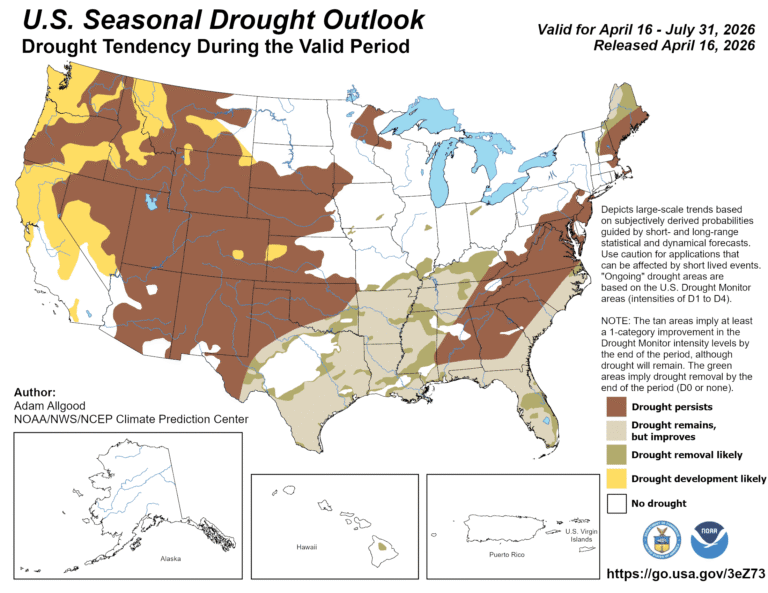
During Summer 2023, much of the western and central United States continued to experience a remarkable recovery from long-term drought. By mid-May, drought covered about one-fifth of the Lower 48 states, according to the U.S. Drought Monitor, down from a peak of 63% in October 2022. Between mid-February and mid-May, drought coverage was more than halved, from 41%-20%. However, because drought had been so deeply entrenched when the wet spell began last autumn, there have been some lingering impacts from the Pacific Coast to the Great Plains.
Notably, groundwater shortages persist in many areas, while some rangeland and pastures have not fully recovered. The varying degrees of drought recovery are also reflected in Western reservoirs. As May began, for example, California’s primary intrastate reservoirs held 28.6 million acre-feet of water, 104% of average for the date. Meanwhile, April 30 storage in the Colorado Basin was 15.5 million acre-feet, just 48% of average. Farther east, drought relief did not arrive in time to revive the central and southern Great Plains’ winter wheat crop. A recent estimate by the U.S. Department of Agriculture indicated that 32.6% of the nation’s winter wheat will be abandoned, which is the highest amount since 1917, including more than 70% of the Texas crop.
Looking ahead to the remainder of the 2023 growing season, the biggest news is that La Niña has fully disappeared for the first time since 2020, with El Niño waiting in the wings. With El Niño appearing imminent, summer could feature hot, dry weather in parts of the western U.S., including the Pacific Northwest and portions of the Four Corners States. Farther east, odds are tilted toward a wet summer in areas from the middle and lower Mississippi Valley to the middle and southern Atlantic Coast.
Brad Rippey is an agricultural meteorologist in the U.S. Department of Agriculture’s Office of the Chief Economist.