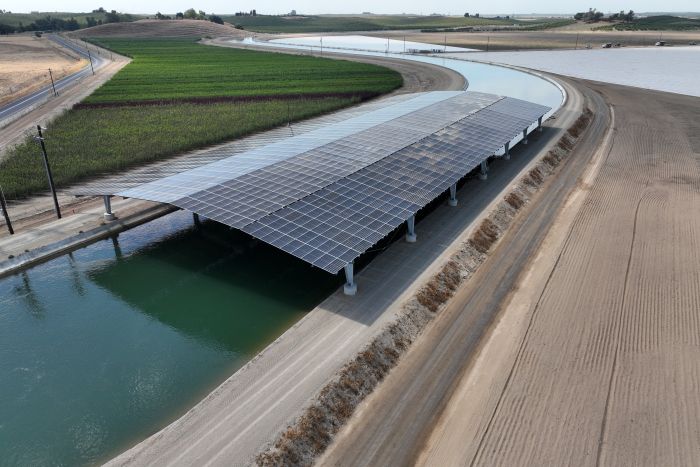
California officials announced the completion of Project Nexus. The pilot program features solar panels over irrigation canals in the Central Valley to test a new approach to water conservation and renewable energy production. The $20 million initiative, backed by the state, combines water infrastructure with solar generation to evaluate whether canal-top solar systems can reduce evaporation, lower maintenance costs and improve water quality.
The project is a collaboration between the California Department of Water Resources, Turlock Irrigation District, SolarAquaGrid LLC and the University of California, Merced. Researchers will study how the system performs in real-world agricultural conditions and whether it can strengthen water infrastructure resilience in drought-prone regions.
Previous research from the University of California, Merced, estimates that covering California’s open canals with solar panels could conserve 63 billion gallons of water annually while also expanding renewable energy capacity without using additional farmland.
Photo courtesy of Turlock Irrigation District.