
Home » News + Features » Sustainability » Closing the gap between irrigation innovation and on-farm application

When Roric Paulman, producer and owner of Paulman Farms, located just south of Sutherland, Nebraska, joined the NASA Acres Farm Innovation Ambassador Team, the role included a tour of the Goddard Space Flight Center.
“We got security clearance to go into the command center, and we all had the chance to look through the Hubble telescope in real time,” he said. “It was like what you see in the movies.”
For a farmer who spends most of his day managing 6,500 acres of diversified crops in the High Plains, this experience is the culmination of decades of work testing how technology can improve on-farm irrigation and nutrient management decisions.
“I farmed on my own for 41 years and worked with industry irrigation partners, and the idea that NASA would put their name on work like this and use unique ways of utilizing some of their LandSat data is exciting,” he said. “It has the potential to use a historical, trusted source of data to answer pressing questions.”
As a member of NASA Acres and NASA Ag’s Farm Innovation Ambassador Team (FIAT), Paulman committed multiple fields to help researchers explore how satellite technology and data can better serve growers.
“Adoption of technology on farms dies somewhere around five to eight percent,” he said. “Participating in programs like NASA’s FIAT helps close that gap.”
A long history of irrigation efficiency work
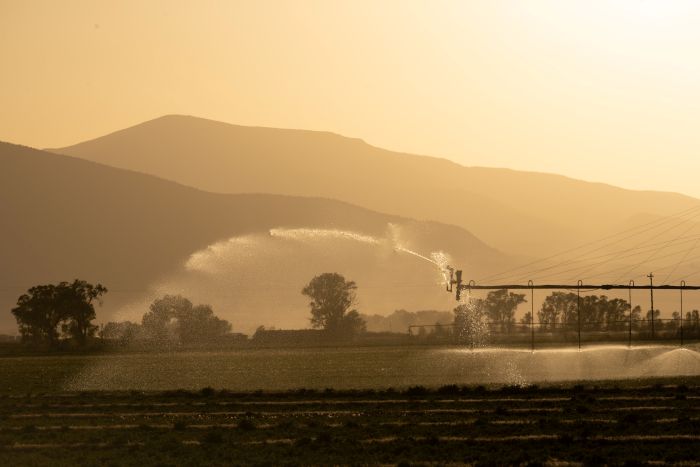
Throughout his farming career, Paulman has tested, provided feedback and been part of development teams on technologies ranging from remote sensing to telemetry for irrigation and water management. He helped start the Nebraska Water Balance Alliance, and he has dedicated countless hours to creating opportunities to evaluate emerging technologies using his farm’s 47 pivots. All of it with one goal in mind—to start conversations about water management, precision nitrogen management, turning data into decisions and building a connected agricultural innovation network.
While he believes in the value technology offers, it must pass practical, real-world tests.
“I’ve invested in a lot of startups related to water and farming, including robotics, and whenever I talk to a hot new startup, I always emphasize the time it takes to get an actionable item,” he said.
When companies bring him a new platform or technology to test, he starts a stopwatch and measures how long it takes to go from the app or web platform to get actionable information. On an early innovation, it tool 90 seconds, and that became what he calls the “Paulman Test.”
If reaching one actionable item takes 90 seconds, Paulman tells developers it’s too long to be effective when you multiple that across 47 pivots. Suddenly, 90 seconds takes more than an hour and a half to make irrigation decisions. The reality is that’s too long to be effective and to encourage in-field adoption.
“I’m in a big project with Google on 25,000 acres where we mounted an Arable Mark III that I helped develop with Jim Ethington, and it calculates ET and gives us rain feedback in real time,” Paulman said. “We can set up an alert that sends us a rain event at 15 hundredths of an inch per hour. In the old days, if that rain event came in at 3 a.m., we had to get up, drive and read the rain gauge because we couldn’t shut it off remotely. Now we get up because we get a text message and can shut it off. That’s a lot of water savings if you’re running a 75 hp motor pumping 750 gallons a minute.”
A look ahead
Paulman never stops seeking opportunities to collaborate, learn, adjust and implement. The NASA FIAT program is another opportunity to keep asking the questions that have followed him throughout his career:
For someone who has spent a lifetime experimenting with what comes next, joining the NASA FIAT program as an ambassador was the logical next step.
“I got to thinking, why not? This is an exciting opportunity to look at these technologies collectively,” he said.
Share on social media:

3030 Clarendon Blvd. | Suite 300 | Arlington, VA 22201
Tel: 703.536.7080 | Fax: 703.536.7019
HOME | ABOUT US | ADVERTISE | SUBSCRIBE | CONTACT | PRIVACY POLICY | IA ANTITRUST STATEMENT