
Home » News + Features » Water » Great Plains & Midwest: Irrigating when groundwater is the constraint
Editors note: This article is the second of a three-part series on drought, starting with the western United States, moving to the Plains and then the East.
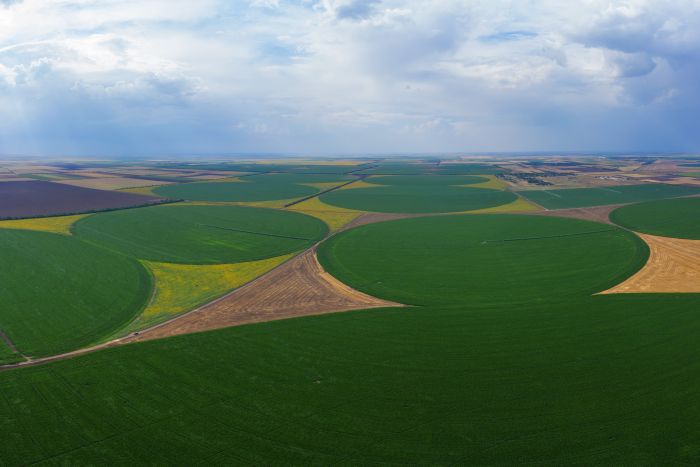
In the Great Plains and parts of the Midwest, drought doesn’t always arrive as a dramatic headline. Often, it shows up more quietly, through wells that don’t pump quite like they used to, higher energy bills and the slow realization that groundwater is becoming a limiting factor for long-term farm planning. In regions dependent on the Ogallala Aquifer drying out, this isn’t only about weather, it’s about capacity.
That reality changes how irrigation fits into the season. When water supplies are constrained by aquifer drawdown or pumping limits, the goal often shifts from “optimize yield at any cost” to something more practical: stretch a finite supply across the season without letting the crop fall apart. That’s the daily decision-making many growers are living with right now.
Planning starts with the basics: knowing what your system can realistically deliver. Well capacity, pumping costs and the number of irrigated acres all set the boundaries for the season. Once those boundaries are clear, irrigation becomes less about running a routine and more about making each event count.
This is where scheduling discipline becomes the most powerful tool on the farm. In groundwater-constrained regions, the biggest losses aren’t always the obvious ones. They come from watering when the profile is already adequate, running longer than needed “just to be safe,” or missing the short windows when irrigation has the highest payoff, like early rooting, pollination, critical crop development or during a heat stretch when stress compounds quickly.
That’s also why many growers are putting more emphasis on measurement. When the margin for error narrows, you want fewer decisions made on guesswork. The value of soil moisture monitoring is that it provides a clear read on what’s happening in the root zone so irrigation can respond to crop demand rather than assumptions. Continuous soil moisture data and real-time operational visibility support more precise irrigation timing and reduce unnecessary water applications when conditions are already adequate. That’s exactly the operational shift that matters in a depletion environment: applying less water overall, not by sacrificing the crop, but by tightening decisions and improving consistency.
Another practical factor is cost. Pumping is expensive, and it gets more expensive as water is pushed farther. Reducing unnecessary sets doesn’t just conserve water, it reduces operating costs in a way growers can feel immediately. Since groundwater management varies widely across the Plains, the farms that can document good water management are often in a better position to adapt to future requirements.
While producers in the Plains have always been adaptive, what’s changing now is the level of constraint and the need for precision under pressure. In a groundwater drought region, irrigation isn’t simply a tool for yield, it becomes a tool for longevity. Proactive growers utilizing precision can stay resilient as the next decade unfolds.
Written with the support of AI.
Val Fishman is advocacy and development consultant for Orbia Precision Agriculture.
Share on social media:
3030 Clarendon Blvd. | Suite 300 | Arlington, VA 22201
Tel: 703.536.7080 | Fax: 703.536.7019
HOME | ABOUT US | ADVERTISE | SUBSCRIBE | CONTACT | PRIVACY POLICY | IA ANTITRUST STATEMENT