
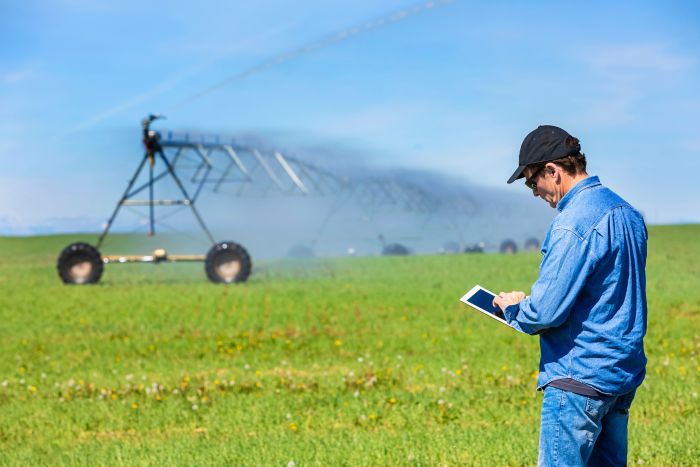
Efficient water use is important throughout the irrigation season and becomes even more critical during the hottest summer months. With weather varying wildly nationwide already this season, from record-breaking heat to flooding and even snow in regions within the same week, one of the most common irrigation questions is, “How do I know when and how much water to apply?”
“Weather can change quickly, and it can be difficult to know whether recent rainfall actually replenished the root zone or if more irrigation is still needed,” said Angie Gradiz, Michigan State University (MSU) Extension agriculture water use efficiency educator. “Many growers are managing multiple fields, crops and daily responsibilities, so regularly checking soil moisture, weather and crop stages can be difficult and time-consuming. I also hear concerns about interpreting the data.”
To help answer these questions, MSU extension specialists and university colleagues, are hosting a Summer Irrigation Workshop. In advance of the workshop, the team shared key takeaways and strategies any grower can use to improve irrigation efficiency regardless of location or crop.
Tools to improve water efficiency
One of the greatest opportunities to improve water efficiency is to make irrigation decisions based on crop needs rather than fixed schedules, according to Gradiz. Conditions vary from field to field, and crop water demands change throughout the growing season. Matching irrigation to those changing conditions helps growers avoid both overwatering and water stress.
“Using tools like evapotranspiration (ET) estimates, soil moisture sensors and weather data allows growers to apply the right amount of water at the right time,” she said. “Bringing these tools together instead of relying on just one source of information, for example, by using soil moisture sensors and weather forecasts together, can help determine whether irrigation can be delayed, which leads to more informed decisions.”
Although mobile apps, remote monitoring and connected irrigation systems have made these tools easier to access, growers still need to understand how to use the information they provide. And soil moisture sensors are one part of the equation that producers still have a lot of questions about.
One of the most common questions Younsuk Dong, PhD, an irrigation specialist in MSU’s Department of Biosystems and Agricultural Engineering, hears from growers about soil moisture sensors is, “Where should I install a soil moisture sensor?” He recommends choosing a location that reflects typical soil, crop and irrigation conditions rather than unusual areas of the field.
“Avoid unusual areas such as field edges, low spots, or locations with known drainage issues,” Dong said. “[The number of sensors] depends on field variability. Some uniform fields may only require one monitoring location, while fields with different soil types or management zones may need multiple sensors to represent conditions accurately.”
Proper installation is just as important as choosing the right location. Dong explained that sensors should have good contact with the surrounding soil and be installed with minimal disturbance to the soil profile.
“Air gaps around the sensor can lead to inaccurate readings,” Dong said.
Following the manufacturer’s installation guidelines and protecting cables and telemetry equipment from machinery, livestock and field operations help ensure reliable data throughout the season.
“Sensor depth should correspond to the crop’s active root zone,” Dong said. “The ideal depths depend on the crop, soil type, rooting characteristics and irrigation system. Monitoring multiple depths provides a more complete picture of soil water movement and helps improve irrigation management decisions.”
Rather than relying on a single data point, growers should combine soil moisture readings with weather forecasts, ET estimates and field observations to guide irrigation decisions throughout the season.
5 scheduling tips for efficiency
Producers also commonly seek advice for deciding on irrigation scheduling. Dong recommends five practices to help growers improve water-use efficiency while maintaining crop performance.
As weather patterns become increasingly unpredictable, irrigation decisions are becoming more complex. Growers who combine ET estimates, weather forecasts, soil moisture measurements and field observations are better positioned to apply water only when and where crops need it, improving efficiency while maximizing yields.
“Ultimately, irrigation scheduling is one of the most cost-effective ways producers can improve water use efficiency,” Gradiz said. “Even small changes like adjusting irrigation after a rainfall event or tracking crop water use can improve water use efficiency, reduce energy costs and maintain crop yields.”
Share on social media:
3030 Clarendon Blvd. | Suite 300 | Arlington, VA 22201
Tel: 703.536.7080 | Fax: 703.536.7019
HOME | ABOUT US | ADVERTISE | SUBSCRIBE | CONTACT | PRIVACY POLICY | IA ANTITRUST STATEMENT