
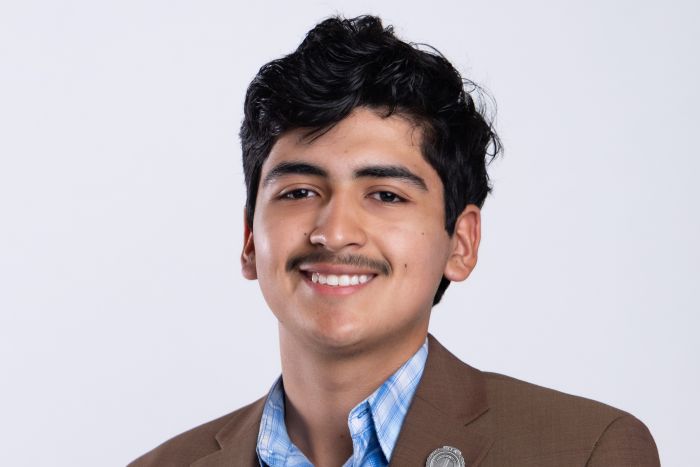
Each year, the Irrigation Association’s Anthony W. “Tony” LaFetra Scholarship program recognizes a group of exceptional students whose passion, dedication and potential reflect a bright future for the irrigation industry. In this special Q&A series, Irrigation Today introduces the 2026 scholarship recipients. These outstanding individuals are already making an impression through their academic achievements, professional goals and commitment to advancing water-efficient practices.
Get to know these emerging leaders as they share their perspectives, inspirations and aspirations, offering a glimpse into the talent and enthusiasm shaping the next generation of our industry.
What does receiving this scholarship mean to you?
I believe that this scholarship is a mark in my journey of being involved in the Colorado River. Since I was a child, I’ve always been interested in nature and outdoors. Only in the past couple years did I narrow my focus into understanding water and what it means for a region like Yuma, Arizona. I’ve been lucky to receive support from Arizona Western College, which provided me access to mentorship with professionals in the field, such as from local irrigation districts and federal agencies like the Bureau of Reclamation and Geological Survey.
What are your future plans in the irrigation or broader industry?
My future plans are to continue developing my network and involvement in local issues as it pertains to the management and utilization of the Colorado River. I would like to one day work for an irrigation district or perhaps a federal agency like the USBR or USGS. I believe that I am in a position where I can bridge my diverse interests to come up with solutions to more sustainably manage the Colorado River. As I continue my educational journey, I also really look forward to educating my peers and the community on how the Colorado River is managed, especially regarding agricultural practices, water use efficiency, habitat conservation, historical changes, and more.
What sparked your interest in this field?
I grew up in San Luis Rio Colorado, Sonora and later moved to San Luis, Arizona. Ever since I was born, my parents have worked in agriculture. Our house in Arizona is also directly adjacent to the Main Drain of the Yuma Valley. Due to this, my exposure to agriculture came very early. I would often take walks with my family around the canals and fields of the area.
As I grew up, I went on to join the San Luis Future Farmers of America (FFA) chapter where I pursued competitions and projects in diverse areas such as wildlife management, animal production, forestry, and much more.
When the time came to start college, I was already set in pursuing agriculture. I pursued the associate degree in Crop Production. One of the requirements of this degree is taking physical geology. I must say that this class triggered the shift to water. My favorite units in class were the groundwater unit, running water unit, and the Colorado River unit. I learned about the water table, river erosion, types of streams, sediment transport, the geological and political history of the Colorado River, and much more.
In my own time, I decided to expand my research. I learned that the canal next to my house was the Main Drain, a drainage canal that collects agricultural runoff from the Yuma valley, served by the Yuma County Water User’s Association. In college I also got accepted into their Agricultural Mentorship Program. In this program, I was paired with the general manager of the Bard Water District. This mentorship has given me hands-on experience as I toured critical irrigation infrastructure such as dams, diversion structures, hydropower facilities, drainage systems, and much more. I also met with water attorneys and oversaw general district operations such as irrigation scheduling, canal/drain maintenance, fallowing programs, reports to the Bureau of Reclamation, etc.
What advice or encouragement would you give to others exploring this career path?
My main piece of advice would be to not be afraid to reach out and ask questions. What got me involved in this field was talking with my geology professor outside of class. We talked about the Colorado river and hydrology in general. Developing a close relationship with her opened up opportunities. For instance, developing this expertise allowed me to gain a mentorship opportunity from the Bard Water District. I later gained connections from other local irrigation districts and federal agencies like the USBR and USGS.
Share on social media:
3030 Clarendon Blvd. | Suite 300 | Arlington, VA 22201
Tel: 703.536.7080 | Fax: 703.536.7019
HOME | ABOUT US | ADVERTISE | SUBSCRIBE | CONTACT | PRIVACY POLICY | IA ANTITRUST STATEMENT