
Home » News + Features » Irrigation » Soil-sensor based irrigation scheduling in high tunnels improves yield and water efficiency
Small-scale and urban farms across Ohio and the Great Lakes region are increasingly using high tunnels to extend the growing season and improve crop production. But maximizing production inside a high tunnel requires more than managing temperature.
Effective irrigation management is equally important, explained Dr. Fernanda Krupek lead of the Urban Food Innovations Team within the department of horticulture and crop science at the Ohio State University College of Food, Agricultural and Environmental Sciences.
To help high tunnel growers improve irrigation efficiency while reducing labor demands, Krupek led a team of researchers in a study comparing two drip irrigation scheduling approaches.
“We were comparing two irrigation scheduling methods,” she said. “The grower’s common practice and sensor-based irrigation.”
In the first scenario, the producer followed their typical irrigation schedule, making decisions based on weather conditions, tunnel ventilation and visual observations of crop and soil conditions. In the second scenario, irrigation was based on real-time soil moisture measurements.
“Soil volumetric water content (VWC) was monitored daily using soil moisture sensors installed at 6-inch depth,” she said. “Irrigation was initiated when the average VWC reached or fell below 17%, indicating moderate soil water depletion within the crop active root zone.”
Krupek explained that literature shows that 50% tomato and pepper active root zone is within the top 12 inches of soil, making this area critical for irrigation management. Using soil moisture sensors, growers applied irrigation until soil moisture increased to approximately 24% VWC, corresponding to replenishment near field capacity.
“Irrigation run times were determined dynamically based on the amount of water required to raise soil moisture level from point of allowable depletion, the moisture content in which plants begin to experience some stress as the roots find it harder to extract water from the soil, to field capacity, the moisture representing the maximum amount of water a soil can hold,” she said.
The results
At its conclusion, the study results showed that sensor-based irrigation outperformed conventional scheduling methods. Yields increased by 20% in ‘Marbonne’ tomatoes and 19% in ‘Capperino’ peppers, while water-use efficiency improved by 130% and 40%, respectively.
“Based on the yield data, in most of the weekly harvests the sensor-based outperformed the standard practices,” she said. “At the end of the growing season, we also observed that we were able to produce more with less water in the sensor-based irrigation. This was an indication that managing irrigation using data-driven approaches, like monitoring soil moisture, were effective in applying appropriate amounts of water to maximize plant growth and yield.”
The team also tested the viability of using a battery-powered controller programmed via Bluetooth from a mobile device.
“One of the challenges during the trial was to ensure that they were at the farm when sensors were indicating the need to turn the irrigation on,” Krupek said. “Even though the battery-powered controller was programmed from a mobile device, it still required us to be within a mile or so radius within the farm perimeter.”
Because many growers may not live at the same location as their high tunnels, the controller’s limited communication range reduced its practicality for some operations. Future studies may include testing remote irrigation control technologies.
The takeaways for high tunnel producers
Based on the results, Krupek shared three pieces of advice for urban producers considering a sensor-based irrigation system.
n crop water needs requires a close look into many components,” Krupek said. “Soil moisture, as we tracked throughout the study, was one of them. But that is only part of the story.”
A look ahead
Building on the initial findings, the research team plans to repeat the study this year at The Ohio State University student farm in Columbus. More details about the trials can be found in the 2025 ePLUS (Produce, Landscape, Urban, Specialty Crops) Report and in a video that explains the project components.
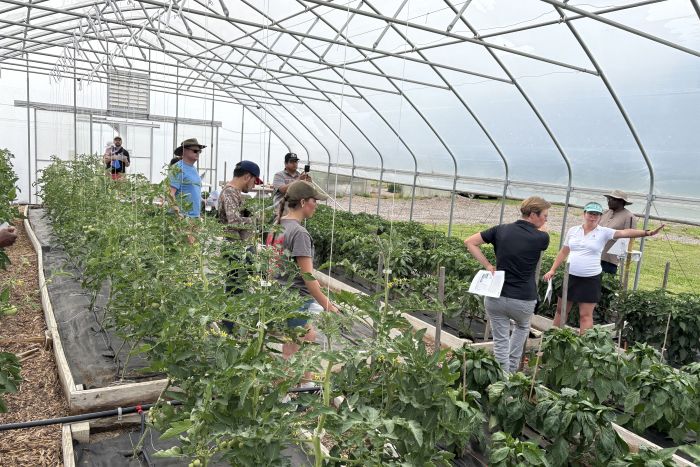
Photo: Field day demonstrating the use of the technology at urban farm were trial was implemented. Photo source: Jim Jasinski
Share on social media:
3030 Clarendon Blvd. | Suite 300 | Arlington, VA 22201
Tel: 703.536.7080 | Fax: 703.536.7019
HOME | ABOUT US | ADVERTISE | SUBSCRIBE | CONTACT | PRIVACY POLICY | IA ANTITRUST STATEMENT