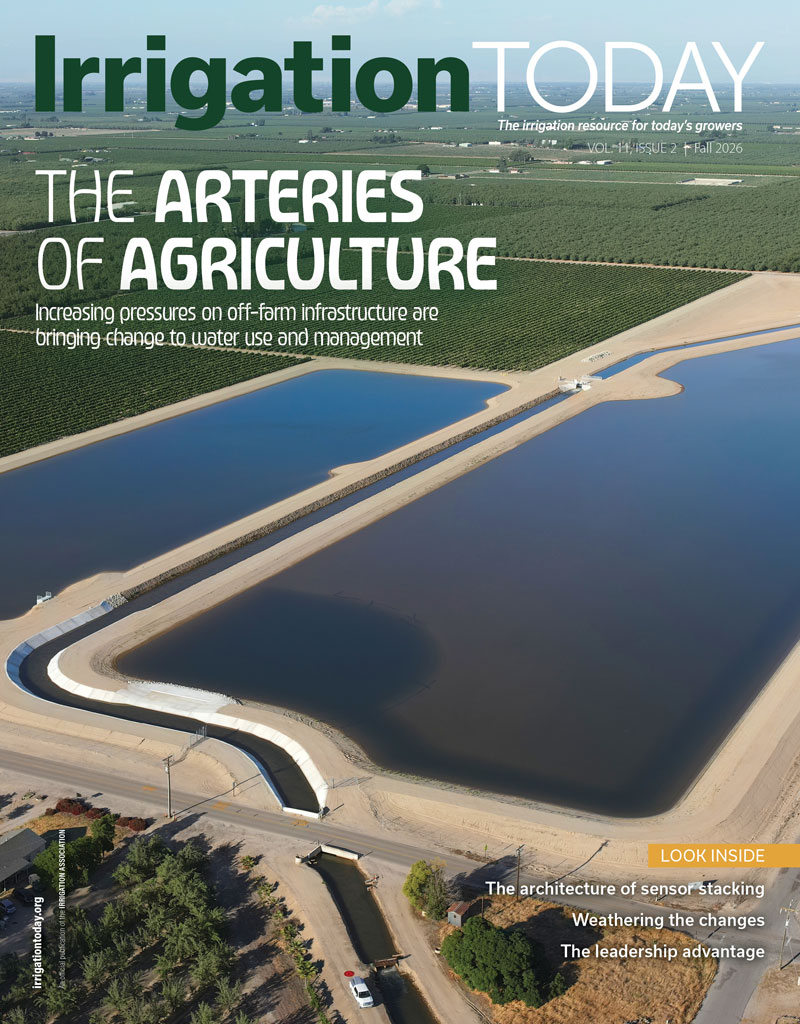
Increasing pressures on off-farm infrastructure are bringing change to water use and management
Agricultural irrigation conversations often center around on-farm infrastructure and the role it plays in supporting efficiency. But in the western United States, irrigation districts play a central role in ensuring water makes it to the on-farm systems.
Many of the 850 irrigation districts, which have more than 147,000 miles of canals and pipelines, were built a century ago. In Fresno, California, for example, the canals and piping were mostly built between 1870 and 1890 by the Fresno Canal & Irrigation Company. The Fresno Irrigation District was founded in 1920. Its nearly 700 miles of gravity-fed canals cover about 250,000 acres, making it one of the larger irrigation districts, and the canals still operate in much the same way they did when they were first built.
When disruptions occur, they remind us that successful irrigation goes beyond the field. Natasha Rankin explores how resilient systems, strong businesses and capable people are the foundation of irrigation performance.
Agricultural water savings initiatives are growing in popularity, but measuring water savings and understanding its actual impact is more complex than it may seem.
Federal investment and innovation in irrigation are aligning, but turning those resources into real results in the field depends on effective implementation.
Ozone is quietly becoming an essential tool for modern irrigation — from controlling biofilm in drip systems to enabling water reuse and improving root-zone health in high-value crops.
The 2026 Irrigation Show and Education Week in Las Vegas (Dec. 7–10) brings new IA University courses, an inaugural Agriculture Policy Exchange Session and the full exhibit floor experience — all in one place for irrigation professionals.
El Niño has returned and could become one of the strongest warm-phase events on record — bringing wetter-than-normal conditions to the Southeast and Four Corners while pushing dryness into the Pacific Northwest.
Relying on a single soil probe is no longer enough. Sensor stacking layers soil, weather and crop physiology data into a unified decision-making platform that helps growers optimize water use and boost yields.
Tariffs, material shortages and shifting global trade patterns are nothing new for the irrigation industry — but companies are developing strategies to adapt while protecting their customers’ bottom lines.
From building culture to developing future talent, effective leadership in the irrigation industry requires practical strategies that engage employees across generations and position businesses for long-term success.